By TIM TUCKER and STEVE WYCHE
The Atlanta Journal-Constitution
Published on: 02/15/06
Arthur Blank continues to pursue a purchase of the Braves.
Blank's representatives have had a series of meetings and discussions with Time Warner about the baseball team, the most recent on Tuesday, several people familiar with the situation told The Atlanta Journal-Constitution.
Blank has been informed of Time Warner's asking price for the team — believed to be slightly upward of $400 million — and talks with him are more advanced than with any other prospective purchaser, sources said. He has not agreed to the asking price or yet made a counteroffer, they said
Sunday, February 19, 2006


High on Josh Rupe: Texas Rangers Ready for Season - Start Spring Training in March
SURPRISE, Ariz. -- Rangers officials met before Spring Training to review club personnel, and rookie pitcher Josh Rupe's name came up for discussion.
As coaches and scouts weighed in around the room, there were those who felt Rupe had an immediate future as the Rangers' fifth starter, and those who envisioned either an eighth-inning setup reliever, or eventually a closer.
A more precise measurement of where Rupe stands might be gauged from the fielding group he has been in during the Rangers' first couple of workouts in the desert.
While incumbent fifth starter Juan Dominguez and other rotation candidates were working on other fields, Rupe was placed in a group that includes Kevin Millwood, Adam Eaton, Vicente Padilla and Kameron Loe.
This is a camp, under the careful eye of manager Buck Showalter and pitching coach Mark Connor, where nothing is done by accident or at random, including putting a rookie like Rupe in the same fielding group as the four established members of the rotation.
"We like this kid and his stuff," Connor said after Friday's workout. "This kid has got the ability to do anything in the Majors. Like Juan Dominguez, it's a matter of consistency."
As coaches and scouts weighed in around the room, there were those who felt Rupe had an immediate future as the Rangers' fifth starter, and those who envisioned either an eighth-inning setup reliever, or eventually a closer.
A more precise measurement of where Rupe stands might be gauged from the fielding group he has been in during the Rangers' first couple of workouts in the desert.
While incumbent fifth starter Juan Dominguez and other rotation candidates were working on other fields, Rupe was placed in a group that includes Kevin Millwood, Adam Eaton, Vicente Padilla and Kameron Loe.
This is a camp, under the careful eye of manager Buck Showalter and pitching coach Mark Connor, where nothing is done by accident or at random, including putting a rookie like Rupe in the same fielding group as the four established members of the rotation.
"We like this kid and his stuff," Connor said after Friday's workout. "This kid has got the ability to do anything in the Majors. Like Juan Dominguez, it's a matter of consistency."
Thursday, January 19, 2006
Red Sox' Theo Esptein Returns Two Months After Escaping in Gorilla Suit (No Kidding)
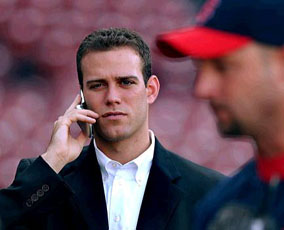
According to the AP, Boston Red Sox GM Theo Epstein returned to the organization in an unspecified role and just two months after quitting the team, and....Well, read the rest below.
BOSTON -- The door was ajar, and Theo Epstein finally walked through it and back into the front office of the Boston Red Sox.
The most successful general manager in franchise history will rejoin the Red Sox baseball operations department in a full-time -- but otherwise unspecified -- position. His long-rumored return comes 2½ months after he turned down a contract extension and fled Fenway Park in a gorilla suit to avoid the encamped media.
"As you know, we have spoken frequently during the last 10 weeks," the team and Epstein said in a joint statement on Thursday night. "We have engaged in healthy, spirited debates about what it will take over the long term for the Red Sox to remain a great organization and, in fact, become a more effective organization in philosophy, approaches and ideals.
"Ironically, Theo's departure has brought us closer together in many respects, and, thanks to these conversations, we now enjoy the bonds of a shared vision for the organization's future that did not exist on Oct. 31. With this vision in place, Theo will return to the Red Sox in a full-time baseball operations capacity, details of which will be announced next week," the statement continued.
Epstein declined to elaborate on the statement, which also came from principal owner John Henry, chairman Tom Werner and president Larry Lucchino. The team would not comment on how Epstein will fit into the organization's hierarchy, but Henry denied that Lucchino's role was diminished to lure Epstein back.
"Larry's role does not change," Henry said. "Details next week."
Lucchino did not immediately respond to an e-mail seeking comment.
The Red Sox have been operating with co-GMs, former Epstein lieutenants Jed Hoyer and Ben Cherington. But their Dec. 12 promotions were overshadowed by persistent rumors that they would soon be working for Epstein again.
"Certainly Theo is a good friend of all of us, and he's worked very closely with these guys in the past," Lucchino said then. "The door has been really ajar for some time, and until Theo goes to work for another baseball organization we'll keep the light on in the window with the possibility of him coming back and helping us."
Epstein's return concludes an almost Shakespearean saga that led him to walk away from the team, reportedly because of a falling out with Lucchino, his longtime mentor. The Red Sox president and chief executive officer first hired Epstein, then a Yale student, to work as an intern with the Baltimore Orioles; Epstein followed Lucchino to the San Diego Padres and rose to assistant GM there.
The Red Sox made Epstein the youngest GM in baseball history in 2003, and his first team came within a Pedro Martinez pitch count of reaching the World Series. The next year, Boston won it all for the first time since 1918.
The Red Sox also reached the postseason in '05 -- a three-year run that was a first in franchise history. But what should have been easy negotiations over a contract extension turned fierce and Freudian.
On Oct. 31, the day his old deal was set to expire, Epstein belied a newspaper report that he had agreed to stay and walked away from the team's three-year, $4.5 million offer.
Explaining his move two days later, Epstein said, "You have to be all-in. You have to believe in every aspect of the job and the organization and your ability to stay and do the job the right way, with your whole heart and your whole soul. And in the end, it just wasn't the right fit. It wasn't right."
Both sides denied -- or at least downplayed -- a rift between Epstein and Lucchino.
"We've had a very successful working relationship," Epstein said in November. "I think Larry and I like each other. As with any long relationship, there are complexities. ... But in the end, I want what's best for Larry. He's done a lot for me. I owe him quite a bit, and I take that to heart."
SF Giants Spring Training and Season Tickets on Sale

Again, the season gets closer! Now SF Giants tickets are on sale. You can get them with a click on the title of this post. This will be an exciting year as Barry Bonds returns in good health and chasing the Home Run title!
Monday, January 16, 2006
Why can newspapers sell baseball statistics content? -- The illogic of MLB's business
Well, here we go. Major League Baseball is working yet again to guard the use of baseball player statistics. What's so illogical about this is the terrific loophole that newspapers take advangtage of.
What do I mean?
Well, sports sections contain stats on players, right? Those same papers have annual fantasy contests based on what those same players do. Plus, those same papers make money off articles written abut the players and the stats they generate.
All this and baseball never touches them at all.
But MLB gives internet companies hell.
What if I have an internet company that reports baseball news using blogs, etc., but then has the same contests that offline newspapers have? Good idea, eh?
If I do that, MLB should not be able to touch me in court.
Right? Right?
I think so. Otherwise, it is a double standard that should not hold up in court.
What do I mean?
Well, sports sections contain stats on players, right? Those same papers have annual fantasy contests based on what those same players do. Plus, those same papers make money off articles written abut the players and the stats they generate.
All this and baseball never touches them at all.
But MLB gives internet companies hell.
What if I have an internet company that reports baseball news using blogs, etc., but then has the same contests that offline newspapers have? Good idea, eh?
If I do that, MLB should not be able to touch me in court.
Right? Right?
I think so. Otherwise, it is a double standard that should not hold up in court.
Sunday, January 15, 2006
LA Angels of Anaheim? Still Reads "LA" to Me - Type "LA Metropolitan Area" in Google and see!

I can understand that the City of Anaheim is upset that they are sharing space in the name "LA Angels of Anaheim" with Los Angeles. But their lawsuit is ill-considered. Why? Well, first their own lease agreement with the organization allows for the use of the name "Anaheim" in some fashion. In fact, the lease reads that team name itself be one "containing Anaheim therein."
Hence "LA Angels of Anaheim."
The City claims that it is losing economic development money by this agreement, which it structured. But really the City should just go ahead and sue anyone and everyone who identifies "Anaheim" with "LA" starting with the search engine company Google.
If you type "LA Metropolitan Area" in Google you get a huge number of listings that will show you what cities and towns the Los Angeles Metropolitan Area contains. Right there is Orange County, and within it Anaheim.
It's funny. Under the logic of the City of Anaheim, it should haul Disney into court for not respecting emiment domain laws and calling Disneyland "Disneyland of Anaheim." Heck, why not. Disneyland is shown as a major destination in the "LA Metropolitan Area."
But under that logic, and since Disneyland has a more prominent listing than the City of Anaheim, perhaps Disney should sue Anaheim for not calling itself "The City of Anaheim: Host To Disneyland."
Well, at least you can't fault Anaheim for having no civic pride. They're a far cry from their sister California city, Oakland. Oakland has no problem giving public money for an arena for a team that doesn't even want to carry the city's name. Of course, we're talking about the Golden State Warriors. They should be called "The Oakland Warriors."
Think of the marketing revenue Oakland's losing. Many people don't even know where "The Golden State" is, or so they tell me.
It's California, you say? Great, but does that mean I have to sit next to Bigfoot in the woods of Northern California to watch a Warriors game? Or do I have to find them in downtown Fresno, only to learn that the team's now playing in Palm Springs? I hope not. If I'm Oakland's tourism chief, I can't work with my own city's basketball team to help me promote the city. That's more than sad, it's sick for one town to allow itself to be used in this way.
Anaheim wouldn't stand for it.
If the Warriors were in Anaheim, they'd be ran out of town for calling themselves 'The Golden State Warriors of Anaheim' rather than the 'Anaheim Warriors.'
Opps...I should have typed "LA Warriors of Anaheim."
Saturday, January 14, 2006
Oakland A's 2006 Tickets Exchange

Yep. It's almost baseball season! 2006 A's tickets can be gotten with a click on the title of this post!
Sunday, January 01, 2006

Thursday, December 29, 2005

Tuesday, December 27, 2005

Friday, December 23, 2005

Chicago Cubs 2006 Tickets on sale already

If you click on this link that follows you will see that Chicago Cubs tickets are already on sale and exchange!
Tuesday, December 20, 2005
Individual tickets for the 2006 season will go on sale on Friday, February 24th.
You can get Cubs tickets by clicking on the title post link. The Cubs will also raise ticket prices for Spring Training over 2005 levels.
Monday, December 12, 2005
Reports: Sox offer Manny for Tejada
It would be cool if the A's could get Tejada back, but let's see how this unfolds....Full news with click on link.
BOSTON -- Manny Ramirez for Miguel Tejada? That's a deal that would hardly do justice to the adjective "blockbuster."
Such a proposal has at least been offered by the Red Sox, according to The Boston Globe and Boston Herald, and also intimated by multiple media outlets in the Baltimore/Washington D.C. area.
Back in late October, word surfaced that Ramirez had asked the Red Sox to trade him, citing an unhappiness with playing in a city which deprived his privacy.
Not long after, the Red Sox confirmed that they promised the slugger they would make a good-faith attempt to trade him.
As the Winter Meetings came to a close on Thursday, Orioles superstar Tejada told a reporter from the Associated Press that he would also like a change of scenery, due to Baltimore's inability to contend in the American League East.
The Red Sox indeed have a shortstop opening that Tejada would fit perfectly into, as the club traded Edgar Renteria to the Braves earlier this week.
While Ramirez and Tejada, two of the game's best offensive players, looks like a great match on paper, there is one issue that could kill even the possibility of such an exchange.
As a 10-5 man (10 years of service time, five with his existing team), Ramirez has the right to veto any trade. Despite doubts about whether Ramirez would accept a trade to the Orioles, a report in Sunday's Washington Post attributed to a source close to Ramirez that he "would 'absolutely' accept a trade to Baltimore."
Efforts by MLB.com to reach Greg Genke, Ramirez's agent, were unsuccessful.
The Red Sox have a club policy of not discussing specific trade rumors.
BOSTON -- Manny Ramirez for Miguel Tejada? That's a deal that would hardly do justice to the adjective "blockbuster."
Such a proposal has at least been offered by the Red Sox, according to The Boston Globe and Boston Herald, and also intimated by multiple media outlets in the Baltimore/Washington D.C. area.
Back in late October, word surfaced that Ramirez had asked the Red Sox to trade him, citing an unhappiness with playing in a city which deprived his privacy.
Not long after, the Red Sox confirmed that they promised the slugger they would make a good-faith attempt to trade him.
As the Winter Meetings came to a close on Thursday, Orioles superstar Tejada told a reporter from the Associated Press that he would also like a change of scenery, due to Baltimore's inability to contend in the American League East.
The Red Sox indeed have a shortstop opening that Tejada would fit perfectly into, as the club traded Edgar Renteria to the Braves earlier this week.
While Ramirez and Tejada, two of the game's best offensive players, looks like a great match on paper, there is one issue that could kill even the possibility of such an exchange.
As a 10-5 man (10 years of service time, five with his existing team), Ramirez has the right to veto any trade. Despite doubts about whether Ramirez would accept a trade to the Orioles, a report in Sunday's Washington Post attributed to a source close to Ramirez that he "would 'absolutely' accept a trade to Baltimore."
Efforts by MLB.com to reach Greg Genke, Ramirez's agent, were unsuccessful.
The Red Sox have a club policy of not discussing specific trade rumors.
True Costs Of Stadium Go Beyond Budget - Washington DC National's Stadium May be Overbudget
For full article, click on the post link
By David Nakamura
Washington Post Staff Writer
Sunday, December 11, 2005; Page C01
Mayor Anthony A. Williams and his top aides have quietly shifted major expenses for a baseball stadium complex out of the city-approved budget of $535 million in the past several months in hopes of persuading the public that the city will spend no more than the amount agreed upon a year ago.
But the District's fiscal commitment to the project has risen above that budget by at least $54 million And it isn't clear who will pay for up to $125 million in additional costs, which would raise the total to $714 million.
Public spending won't exceed $535 million, the mayor said. (Tetona Dunlap - Tetona Dunlap)
Although Williams (D) declared publicly last week that the project would not go over budget, the D.C. Council amended the stadium legislation last month to add $54 million in bond financing fees. The change was made at the request of D.C. Chief Financial Officer Natwar M. Gandhi, who called the amendment minor but acknowledged that it increased the city's commitment to $589 million.
"I feel thoroughly hoodwinked," said Jim Graham (D-Ward 1), who, like several other council members, said he was unaware that the action authorized the larger budget. "The council sat in blissful ignorance and approved technical amendments that expanded the budget by $50 million. . . . It's time for the council of the District of Columbia to say, 'Enough is enough.' "
From the time Williams announced the arrival of a Major League Baseball team in September 2004, his administration has understated the costs of the stadium project at several critical points, in part to help sell the deal to a skeptical council. As costs have risen in every major category for the project along the Anacostia River in Southeast Washington -- buying the land, building the stadium and paying for infrastructure -- the administration has removed project expenses and placed them in a separate category of costs that remain unfunded.
The approved budget plus the unfunded costs could reach $714 million, Gandhi told city officials last week in a private meeting.
The result is that with less than three months before the city had planned to break ground on the stadium, city leaders have rekindled a debate over the true public costs and the project remains in political limbo.
New uncertainty has prompted the council to explore building near Robert F. Kennedy Memorial Stadium to reduce costs. Tomorrow, the council expects to receive a more detailed study from Gandhi that will compare the Anacostia site to the RFK location.
In the meantime, concerns about rising costs will influence the council's vote next week on the city's stadium lease agreement, which baseball wants approved before it sells the Washington Nationals.
At a news conference last week, Williams again said, "The entire project will not cost more than $535 million."
He emphasized that bond financing fees should not be counted against the budget because they will not be covered by money from the general fund. Instead, the city will use revenue generated for the city by the Nationals' first season and by interest earned on the bonds next year before the bond money is spent on construction. He expects private developers and the federal government to cover expensive infrastructure upgrades to roads and a Metro station, expenses once covered by the $535 million stadium budget.
Most city leaders, however, remain focused on the dramatic cost increases of the past year.
By David Nakamura
Washington Post Staff Writer
Sunday, December 11, 2005; Page C01
Mayor Anthony A. Williams and his top aides have quietly shifted major expenses for a baseball stadium complex out of the city-approved budget of $535 million in the past several months in hopes of persuading the public that the city will spend no more than the amount agreed upon a year ago.
But the District's fiscal commitment to the project has risen above that budget by at least $54 million And it isn't clear who will pay for up to $125 million in additional costs, which would raise the total to $714 million.
Public spending won't exceed $535 million, the mayor said. (Tetona Dunlap - Tetona Dunlap)
Although Williams (D) declared publicly last week that the project would not go over budget, the D.C. Council amended the stadium legislation last month to add $54 million in bond financing fees. The change was made at the request of D.C. Chief Financial Officer Natwar M. Gandhi, who called the amendment minor but acknowledged that it increased the city's commitment to $589 million.
"I feel thoroughly hoodwinked," said Jim Graham (D-Ward 1), who, like several other council members, said he was unaware that the action authorized the larger budget. "The council sat in blissful ignorance and approved technical amendments that expanded the budget by $50 million. . . . It's time for the council of the District of Columbia to say, 'Enough is enough.' "
From the time Williams announced the arrival of a Major League Baseball team in September 2004, his administration has understated the costs of the stadium project at several critical points, in part to help sell the deal to a skeptical council. As costs have risen in every major category for the project along the Anacostia River in Southeast Washington -- buying the land, building the stadium and paying for infrastructure -- the administration has removed project expenses and placed them in a separate category of costs that remain unfunded.
The approved budget plus the unfunded costs could reach $714 million, Gandhi told city officials last week in a private meeting.
The result is that with less than three months before the city had planned to break ground on the stadium, city leaders have rekindled a debate over the true public costs and the project remains in political limbo.
New uncertainty has prompted the council to explore building near Robert F. Kennedy Memorial Stadium to reduce costs. Tomorrow, the council expects to receive a more detailed study from Gandhi that will compare the Anacostia site to the RFK location.
In the meantime, concerns about rising costs will influence the council's vote next week on the city's stadium lease agreement, which baseball wants approved before it sells the Washington Nationals.
At a news conference last week, Williams again said, "The entire project will not cost more than $535 million."
He emphasized that bond financing fees should not be counted against the budget because they will not be covered by money from the general fund. Instead, the city will use revenue generated for the city by the Nationals' first season and by interest earned on the bonds next year before the bond money is spent on construction. He expects private developers and the federal government to cover expensive infrastructure upgrades to roads and a Metro station, expenses once covered by the $535 million stadium budget.
Most city leaders, however, remain focused on the dramatic cost increases of the past year.


