The truth about Bonds
FROM STAFF REPORTS
ALL EYES are on Barry Bonds.
Major League Baseball's investigators are watching him. Congress is watching him. The FBI and the IRS may be watching, too. And millions more will watch Bonds' every move this season as he takes aim at the all-time home run record.
Bonds' accomplishments are among the greatest in baseball history, and the greatest in question. For some, he will always be the ultimate symbol of the game's steroid era.
But whether you cheer his climb up the charts or view him as a loathsome cheat, it is easy to be confused on the facts as they pertain to Barry Lamar Bonds. With the Giants set to open the season Monday in San Diego, we attempt to clarify all things Bonds with answers to the 20 most common questions.
1. Where does Bonds stand on the all-time home run list?
Bonds has 708 home runs, which ranks third all-time behind Babe Ruth (714) and Hank Aaron (755).
2. What will happen if Bonds passes Babe Ruth?
The Giants have said they would commemorate the occasion. If it happens at home, expect the game to be stopped and the moment to be acknowledged. Major League Baseball would get involved in the planning if Bonds begins to close in on Aaron's record.
3. How much will Bonds play this year, and is this his last season?
If he stays reasonably healthy, Bonds could play up to 120 games (out of 162). His contract expires after this season and he is preparing for this to be the end. But if he remains healthy and productive, he would seize the chance to get paid for another year. He says he'll know by midseason.
4. Will Bonds finish his career as a Giant?
That's his stated intention. He hasn't ruled out becoming a designated hitter in the American League, but the Angels don't want any part of his baggage.
5. How has Bonds looked this spring?
His bat remains otherworldly. He was 9-for-13 with four home runs in Cactus League exhibitions. Bonds also showed much improved mobility in left field from last year, when three right knee surgeries limited him to 14 games. Expect Bonds to be pitched around often.
6. How 'real' will Bonds' ESPN reality show be?
It won't be in the mold of "Fat Actress." Producer Michael Tollin pledges a fair and classy documentary-style show that mostly deals with Bonds the baseball player. Tollin insists it will include some discussion of steroids. But Bonds has review rights, so expect it mostly to reflect on Bonds' greatness as a player.
7. What was revealed in the two books on Bonds this spring?
"Game of Shadows" was written by San Francisco Chronicle investigative reporters Mark Fainaru-Wada and Lance Williams. Citing three years of gathered documents, affidavits, interviews and other evidence, it asserts that Bonds regularly used a large and varied amount of potent performance-enhancing drugs starting in 1999. "Love Me, Hate Me," by former Sports Illustrated writer Jeff Pearlman, is more of an anecdotal look at Bonds through the eyes of opposing players and former teammates, including some who accuse him of steroid use.
8. Why did Bonds file suit against the authors and publisher of "Game of Shadows"?
Bonds' attorney, Michael Rains, sued to have the book's profits given to charity, not to keep it from being released. The suit claimed the authors violated unfair competition laws because they published sealed grand jury testimony from the BALCO case — something other writers did not have access to. A judge refused to issue a temporary restraining order on the profits and said he did not think the case had merit but could go to trial. Rains says he has not ruled out a libel case, but it would be messy and difficult to prove — and impossible if Bonds actually used steroids.
9. Is the BALCO case over?
President Victor Conte, Vice President James Valente and Bonds' personal trainer, Greg Anderson, took a plea deal and were convicted of conspiracy to distribute steroids. Anderson and Conte also were convicted of money laundering. Conte received the most prison time — four months, which he finished Thursday, to be followed by four months of house arrest. Anderson served three months in prison and is currently serving three months of house arrest. Valente received probation.
10. Does Greg Anderson still train Bonds?
Yes. According to Bonds, the two remain friends and workout partners.
11. Could Bonds still be investigated on perjury charges for his grand jury testimony in the BALCO case?
Federal investigators are within the statute of limitations but likely would have pursued perjury or obstruction of justice charges already if the case were viable. If Bonds makes conflicting statements about steroid use in the future, such as a flat-out admission, he could face federal charges.
12. Will the IRS investigate Bonds?
It's a distinct possibility. His former mistress, Kimberly Bell, contends that Bonds used unreported income from autograph and memorabilia sales to give her a down payment on a house. She reportedly has some documented records to back up her claims.
13. Will Congress subpoena Bonds and/or other ballplayers for more hearings?
Bonds was a curious omission from the House Government Reform Committee's list of players who were subpoenaed in 2005, and his involvement in the BALCO case was cited as the reason. With those proceedings concluded, it's possible Bonds could be hauled in to testify. As he gets closer to Aaron's record, it will be even more tempting for members of the committee to make themselves part of the story.
14. Why is Major League Baseball investigating Bonds?
It's all about the home run record. And money, of course. Commissioner Bud Selig is under perceived pressure from the fans and media, and actual pressure from Congress and sponsors, to take a hard look at Bonds because Hank Aaron's record is considered the game's most precious. National sponsors such as Bank of America and Home Depot have pulled their support of a Bonds celebration campaign unless an investigation shows Bonds did not use performance-enhancing substances.
15. Who is heading up MLB's investigation, and when will it be resolved?
Selig asked close friend and former U.S. Senator George Mitchell to head the so-called independent probe. The last time MLB ordered an investigation of this kind, it took Washington lawyer John Dowd three months to produce a 225-page report detailing the evidence that Pete Rose bet on baseball. It took nearly four more months before Commissioner A. Bartlett Giamatti reached an agreement to ban Rose for life in August 1989.
16. Can Major League Baseball suspend Bonds?
Selig has broad powers under the "best interests of baseball clause." But invoking the clause to discipline Bonds would draw an immediate grievance from the Players' Association, and likely would be overturned. When Rose was banned, he was not protected by the union. However, Bonds could be banned from the sport upon his retirement, which would keep him out of the Hall of Fame.
17. Will there be an asterisk next to Bonds' records?
Hall of Famer Frank Robinson has said any proven steroid user should have his records completely erased. But that's not practical, given the lack of facts prior to 2003. Expect Bonds' records to stand unless Selig's investigation turns up proof that the slugger used steroids — or Bonds tests positive this season.
18. Has Bonds ever failed a league-sanctioned drug test?
Unlike Rafael Palmeiro, Bonds has not tested positive for banned substances since penalties were made public in 2004. Bonds also claims he didn't test positive in'03, when violators were kept private.
19. Is it possible Bonds is using performance-enhancing drugs now?
Yes. Human growth hormone requires a blood test to detect, and the union has not agreed to that. Also, new designer steroids are being created in labs all the time. It's possible some players are using stuff that can't be detected, including Bonds.
20. Did Bonds use steroids?
It's the one burning question. While some players are suspected as users based solely on appearance and other anecdotal factors, a significant and compelling amount of circumstantial evidence exists that ties Bonds to steroid use. But ultimately, there still isn't a smoking syringe.
Sunday, April 02, 2006


Thursday, March 30, 2006
BALCO Chief Victor Conte: Book "Game of Shadows" "Is Full Of Lies" - Conte Released From Jail
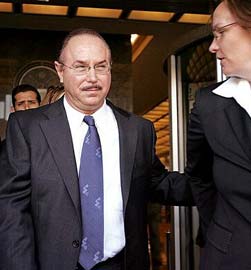
Wow, this is the real smoking gun in the form of BALCO Chief Victor Conte, who upon being released from jail, held a press conference to declare that the book "Game of Shadows," which claims that Barry Bonds used steroids, is "full of lies." It comes one day after my post on my book review.
Here's the article from MLB.com
SAN MATEO, Calif. (AP) -- BALCO founder Victor Conte insisted Thursday that he never gave performance-enhancing drugs to Barry Bonds and that a new book that makes those claims is "full of outright lies."
Conte spoke to The Associated Press outside his San Mateo home hours after his release from prison, where he spent four months after pleading guilty to orchestrating an illegal steroids distribution scheme that allegedly involved many high-profile athletes, including Bonds.
Asked whether he gave Bonds performance-enhancing drugs, Conte said: "No, I did not."
A new book, "Game of Shadows," by two San Francisco Chronicle reporters, chronicles the founding of the Bay Area Laboratory Co-Operative and details alleged extensive steroid use by Bonds and other baseball stars. Baseball Commissioner Bud Selig announced Thursday that former Senate Majority Leader George Mitchell will lead an investigation into the claims.
"I plan to provide evidence in the near future to prove that much of what is written in the book is untrue," Conte told The AP. He declined to list specific inaccuracies or what evidence he would provide, but said the book is "about the character assassination of Barry Bonds and myself."
"It's my opinion that the two writers of the book have a disease called fabrication-itis," Conte said, holding a copy of "Game of Shadows" as he stood on his front steps.
The book's authors, Lance Williams and Mark Fainaru-Wada, were on an airplane Thursday and not available for comment.
Lisa Johnson, a spokeswoman for Gotham Books, which published "Game of Shadows," said: "Gotham Books stands by Lance Williams and Mark Fainaru-Wada, and we stand by their research."
"We stand by the reporting that Mark and Lance did throughout this story and in all the stories that were published in the paper," Chronicle executive vice president and editor Phil Bronstein said. "And if and when Mr. Conte speaks further about this, I'm sure we'll report about that as well."
Conte was picked up by his family after his 5:30 a.m. release from Taft Correctional Institution, about 40 miles southwest of Bakersfield, according to spokeswoman Mandy Ruff.
About five hours later, Conte arrived at his green two-story house in San Mateo, about 20 miles south of San Francisco, in a white sports utility vehicle with darkened windows.
Wearing blue jeans, a red sweat shirt and a baseball cap, Conte said "it feels great" to be out of prison. He said prison was "like a men's retreat," during which he read, gave music lessons to fellow inmates, coached a sprinting team and participated in a debate about steroids.
Conte founded and managed the Burlingame-based BALCO, where the steroids were sold. He pleaded guilty to money laundering and a steroid distribution charge, and dozens of other charges were dropped as part of his plea deal.
Conte was sentenced in October to four months in prison and four months' home confinement in a plea deal with federal prosecutors.
Baseball investigators could seek to interview Conte about steroid use in the game.
Bond, who has denied using steroids, was the most prominent athlete linked to BALCO. He testified in December 2003 to the federal grand jury investigating the case but has not been charged with a crime.
Other baseball players linked to BALCO include Yankees stars Jason Giambi and Gary Sheffield.
Olympic track and field stars Marion Jones and Tim Montgomery and former NFL player Bill Romanowski also were called to testify in front of the grand jury. No athletes were charged in the scheme.
Greg Anderson, Bonds' personal trainer, was sentenced to three months behind bars and an additional three months of home confinement after pleading guilty to money laundering and a steroid distribution charge.
BALCO vice president James Valente was sentenced to three years' probation, and track coach Remi Korchemny received a year of probation.
ESPN Gets It Right - MLB Commissioner Selig Pulls The Trigger: Established Steriod Use Investigation Headed By George Mitchell

Yesterday, I accused ESPN of trying to push the Commissioner of Major League Baseball to take action on the basis of what I contend is a poorly presented book claiming that one player -- Barry Bonds -- used steroids.
Well, unlike the last time, ESPN did get this right. Check out the news below and with a click to the link that is the title of this post.
03/30/2006 2:00 PM ET
Selig announces steroid investigation
Former Sen. George Mitchell named to head probe into past drug use
By Barry M. Bloom / MLB.com
NEW YORK -- Commissioner Bud Selig has named former Sen. George Mitchell to head a full-scale investigation into the past use of performance-enhancing drugs in Major League Baseball.
The announcement came at a press conference at the Commissioner's office on Thursday.
The probe was spurred by recent allegations made in a book that targets San Francisco Giants slugger Barry Bonds and Gary Sheffield and Jason Giambi of the New York Yankees, among a number of other former Major Leaguers.
The book, entitled "Game of Shadows," alleges that Bonds used performance-enhancing drugs beginning in 1998 for a five-year period, which includes 2001, when he hit 73 home runs to set a single-season record.
Bonds has been the focal point of controversy since leaked grand jury testimony during the 2004-2005 offseason linked him to steroid use. Bonds will resume his chase of the all-time career homer record when the Giants open their season against the Padres in San Diego on Monday. Bonds, at 708, is six homers in arrears of Babe Ruth and 47 behind Hank Aaron, the all-time leader with 755.
All the players involved will be allowed to play while the probe is under way.
MLB did not have random testing for steroids and other performance-enhancing drugs prior to 2003, though Selig circulated memos during the 1990s stating that the use of those drugs by players was strictly prohibited and could be cause for discipline. The players association would not collectively bargain the issue at the time.
Don Fehr, the executive director of the union, said on Monday that under those terms, players could only be tested and penalized when MLB officials had "just cause" to believe a Major Leaguer was doing such drugs. MLB never announced player penalties then and have not reported that either Bonds, Giambi or Sheffield have failed a drug test since the twice re-written MLB drug policy went into effect four years ago.
What discipline Selig can hand out after the investigation is complete is a matter of conjecture. The union has a representational obligation to any of the players involved, Fehr said.
"I hope nobody is making judgments about the inquiry before it's done," said Fehr, who met with Bonds at his Scottsdale Stadium locker for 20 minutes on Monday after the union's annual spring session with the Giants players. "Bud will make whatever decision Bud makes and we'll go from there."
The book, which was written by two San Francisco Chronicle reporters who covered the federal investigation into the Bay Area Laboratory Cooperative (BALCO), says Bonds used a host of steroid-based drugs to improve his strength, play and recovery time from injuries.
The authors say Sheffield and Giambi were also extensive steroid users and link the pair to Bonds and his personal trainer, Greg Anderson, who was indicted in the BALCO case, pled guilty to reduced charges, and was sentenced to jail time. Victor Conte, the president of the now-defunct company, also pled to lesser charges and served a four-month prison sentence. In a bit of ironic timing, Conte was being released Thursday.
Earlier this month, after excerpts of the book were published in Sports Illustrated, Selig said he would review all the pertinent information pertaining to Bonds' alleged steroid use and reserve comment about it. Selig has been under increased pressure from Congressional leaders and the media to open an investigation into just what happened in the Major Leagues during the era that began in 1998 when Mark McGwire and Sammy Sosa chased and broke Roger Maris' single-season, 37-year-old home run record of 61.
Bonds missed all but 14 games of the 2005 season after having surgery three times on his right knee. Bonds returned on Sept. 12 and hit five homers in his first 36 at-bats.
He has hit four more this spring in 16 at-bats while batting .625. Though Bonds has not played since Friday because of inflammation in his left elbow, he is expected to be back in the lineup on Thursday night when the Giants play an exhibition game against the Los Angeles Angels at San Francisco's newly renamed AT&T Park.
Barry M. Bloom is a national reporter for MLB.com. This story was not subject to the approval of Major League Baseball or its clubs.
Wednesday, March 29, 2006
"Game Of Shadows" - The Book On Barry Bonds and Steroids Reads More Like a Bad "Kiss and Tell" Novel Than A Smoking Gun Linking Bonds to Steroid Use
I purchased the new book "Game of Shadows" on Monday evening after spotting it in my face at a local bookstore on Chestnut Street in San Francisco's Marina District. Even though I wrote negative press about the intentions of the San Francisco Chronicle and it's two writers work based on the excerpt I read in that newspaper, I always planned to buy and read the book.
I'm on Chapter 12 now.
I'm reading the book from four different perspectives: entertainment value, research quality and presentation, persuasiveness, and "agenda" -- in other words, does it seems that the writers have a bone to pick with Bonds, as opposed to really getting at the story behind the story and the "truth."
Well, here's my scores in each category and I doubt I'll find any part of the book to make me alter them significantly:
Entertainment Value - A
Research Quality and Presentation - D
Persuaveness - D
Agenda - F
Entertainment Value
The book scrores high because it's an interesting gossipy look at Bonds, baseball and the players involved in the steriods Story, especiallly the "BALCO" matter, which received a lot of local press, most of it from the San Francisco Chronicle.
Lance Williams and Mark Fairnaru-Wada do a good job of mixing some facts with heresay and where they use the latter it's in a sentence or paragraph where someone's colorful language is being presented. I came away with a feeling for the players in the story, even if the book seems to jump from one episode to the other.
Because all of this has been in the San Francisco Chronicle, the book feels like it's more a combination of many articles written over the last two years. (Keep that sentence in your head.) Thus, it's a book that compells Bay Area sports fans to read it, if only to fill in the blanks created by those Chronicle works one may have missed reading.
Research Quality and Presentation
This is where the "D" grade fits. The book is terribly researched and presented. If Mark and Lance are going to make these powerful accusations regarding Bonds steriod use, they should have known to carefully footnote each and every statement and sentence reporting what someone did or said. But they don't do this. Selected words are highlighted and for them a sentence on a newspaper article or "unidentified scource" is written next to it.
But if that citation is anything, it's not a real citation; it never lists the author or volume and page of the newspaper article or magazine work or book. Plus, many of the source notes do read "SFC" which is "San Francisco Chronicle" and if it's Mark and Lance's own work, it violates a basic research rule that you don't site your own work repeatedly, but see what others have written on that matter.
Bad.
The point of a good, well researched book is that I should be able to take it and replicate what the writers have done. I can't do that with Mark and Lance's book. Given the gravity of their accusations, I should be able to do that.
Moreover, it's -- as I wrote -- selective in what is sourced. For example, the authors report in Chapter 11 that the Giants Slugger gave his girlfriend Kim Bell $1,000 to get back to California after the September 11th 2001 attacks. But a look in the notes for that chapter can't reveal the source of that information. It's not there. I don't want to infer, and a good research book should not force the reader to do so. There are many examples of unsourced information like that one in this book, and collectively the poor presentation makes me very angry because it negatively impacts...
Persuasiveness
Here's a D grade, and it's not an "F" grade because some of their points are generally known, but where you're looking for smoking gun information, it's not there at all. Empty. The writers make blanket statements regarding how Bonds may have -- for example -- talked to Jason Giambi, but provide zero evidence to back up their claims. This is a constant pattern in the book and makes for a sloppy argument at best.
Here's another example that really ticked me off:the writers report that Bonds was using a kind of performance enhancing drug, which they write is not a steroid, but then include a "guessing" line that it could become a steroid if it were mixed with two other drugs -- but they don't prove Bonds did this. They play close to the edge, too close.
It's for this reason in part that I think the authors had an agenda, and why they scored an "F" in that area. There's no balanced presentation here.
Agenda
A big fat "F."
In the over 100 pages of text I've read thus far, there's not one positive paragraph about Barry Bonds the person. The lone supportive paragraph reports Bonds well-known home run stats, but that's it.
The rest is a collection of surmised words on Bonds' relationship with his father (terrible and combative) and choice sentences on Bonds marriage to Sun Bonds. But in both we're treated to the worst comments Bonds may have made, but then left wondering why the court judgement came out in Barry's favor and why in his final days with his father they seemed so chumy.
Look, just because Barry may have been unavailable to you, the journalist, don't mean you have to attempt to match or surpass his treatment of you. One thing this episode has shown is just how few Christians are in America's sports newsrooms.
ESPN Gets It Wrong Again
ESPN reports that the evidence proving Bonds' use of steroids is "powerful." I assert that anyone who makes that claim flunked English and basic research -- which is probably true. There's no "powerful evidence" here; only several attempts to string "possible events" together. That's a joke; the man's innocent until proven guilty and this does not do it. If I were Barry, I'd fire my current legal counsel, and hire Johnny Cochran's law firm. Why" Because the mix of racist commentary and misinformation adds up to libel, and I believe that in this specific case African American legal counsel will see the serious racism that comes through in this book, and shed more light on it than I have.
The other thing that's sick about "The Worldwide Leader" is their constant attempts to move Major League Baseball to investigate the matter of steroid use by Barry Bonds by false reporting. That's right: false reporting. First, they blabbed that the Commissioner of Baseball was going to take action, when Bud Selig never said anything to cause anyone to even remotely come to that conclusion.
Now, ESPN reports that Major League Baseball's going to establish a commission to investigate the use of steroids, when there's no statement from baseball either in a press release or at its website. ESPN claims this annoucement will come tommorrow and from baseball.
This is the worst abuse of the media airwaves. ESPN should be fined by the FCC and for $10 million. This, I'd push for. The FCC needs to get involved and set some standards for reporting here.
I'm very confident the Chronicle could be beaten in court. The rag's very lucky Barry's got a lawyer who's more interested in getting his name on radio and TV than in winning court cases for his client. `
I'm on Chapter 12 now.
I'm reading the book from four different perspectives: entertainment value, research quality and presentation, persuasiveness, and "agenda" -- in other words, does it seems that the writers have a bone to pick with Bonds, as opposed to really getting at the story behind the story and the "truth."
Well, here's my scores in each category and I doubt I'll find any part of the book to make me alter them significantly:
Entertainment Value - A
Research Quality and Presentation - D
Persuaveness - D
Agenda - F
Entertainment Value
The book scrores high because it's an interesting gossipy look at Bonds, baseball and the players involved in the steriods Story, especiallly the "BALCO" matter, which received a lot of local press, most of it from the San Francisco Chronicle.
Lance Williams and Mark Fairnaru-Wada do a good job of mixing some facts with heresay and where they use the latter it's in a sentence or paragraph where someone's colorful language is being presented. I came away with a feeling for the players in the story, even if the book seems to jump from one episode to the other.
Because all of this has been in the San Francisco Chronicle, the book feels like it's more a combination of many articles written over the last two years. (Keep that sentence in your head.) Thus, it's a book that compells Bay Area sports fans to read it, if only to fill in the blanks created by those Chronicle works one may have missed reading.
Research Quality and Presentation
This is where the "D" grade fits. The book is terribly researched and presented. If Mark and Lance are going to make these powerful accusations regarding Bonds steriod use, they should have known to carefully footnote each and every statement and sentence reporting what someone did or said. But they don't do this. Selected words are highlighted and for them a sentence on a newspaper article or "unidentified scource" is written next to it.
But if that citation is anything, it's not a real citation; it never lists the author or volume and page of the newspaper article or magazine work or book. Plus, many of the source notes do read "SFC" which is "San Francisco Chronicle" and if it's Mark and Lance's own work, it violates a basic research rule that you don't site your own work repeatedly, but see what others have written on that matter.
Bad.
The point of a good, well researched book is that I should be able to take it and replicate what the writers have done. I can't do that with Mark and Lance's book. Given the gravity of their accusations, I should be able to do that.
Moreover, it's -- as I wrote -- selective in what is sourced. For example, the authors report in Chapter 11 that the Giants Slugger gave his girlfriend Kim Bell $1,000 to get back to California after the September 11th 2001 attacks. But a look in the notes for that chapter can't reveal the source of that information. It's not there. I don't want to infer, and a good research book should not force the reader to do so. There are many examples of unsourced information like that one in this book, and collectively the poor presentation makes me very angry because it negatively impacts...
Persuasiveness
Here's a D grade, and it's not an "F" grade because some of their points are generally known, but where you're looking for smoking gun information, it's not there at all. Empty. The writers make blanket statements regarding how Bonds may have -- for example -- talked to Jason Giambi, but provide zero evidence to back up their claims. This is a constant pattern in the book and makes for a sloppy argument at best.
Here's another example that really ticked me off:the writers report that Bonds was using a kind of performance enhancing drug, which they write is not a steroid, but then include a "guessing" line that it could become a steroid if it were mixed with two other drugs -- but they don't prove Bonds did this. They play close to the edge, too close.
It's for this reason in part that I think the authors had an agenda, and why they scored an "F" in that area. There's no balanced presentation here.
Agenda
A big fat "F."
In the over 100 pages of text I've read thus far, there's not one positive paragraph about Barry Bonds the person. The lone supportive paragraph reports Bonds well-known home run stats, but that's it.
The rest is a collection of surmised words on Bonds' relationship with his father (terrible and combative) and choice sentences on Bonds marriage to Sun Bonds. But in both we're treated to the worst comments Bonds may have made, but then left wondering why the court judgement came out in Barry's favor and why in his final days with his father they seemed so chumy.
Look, just because Barry may have been unavailable to you, the journalist, don't mean you have to attempt to match or surpass his treatment of you. One thing this episode has shown is just how few Christians are in America's sports newsrooms.
ESPN Gets It Wrong Again
ESPN reports that the evidence proving Bonds' use of steroids is "powerful." I assert that anyone who makes that claim flunked English and basic research -- which is probably true. There's no "powerful evidence" here; only several attempts to string "possible events" together. That's a joke; the man's innocent until proven guilty and this does not do it. If I were Barry, I'd fire my current legal counsel, and hire Johnny Cochran's law firm. Why" Because the mix of racist commentary and misinformation adds up to libel, and I believe that in this specific case African American legal counsel will see the serious racism that comes through in this book, and shed more light on it than I have.
The other thing that's sick about "The Worldwide Leader" is their constant attempts to move Major League Baseball to investigate the matter of steroid use by Barry Bonds by false reporting. That's right: false reporting. First, they blabbed that the Commissioner of Baseball was going to take action, when Bud Selig never said anything to cause anyone to even remotely come to that conclusion.
Now, ESPN reports that Major League Baseball's going to establish a commission to investigate the use of steroids, when there's no statement from baseball either in a press release or at its website. ESPN claims this annoucement will come tommorrow and from baseball.
This is the worst abuse of the media airwaves. ESPN should be fined by the FCC and for $10 million. This, I'd push for. The FCC needs to get involved and set some standards for reporting here.
I'm very confident the Chronicle could be beaten in court. The rag's very lucky Barry's got a lawyer who's more interested in getting his name on radio and TV than in winning court cases for his client. `
Tuesday, March 28, 2006
Mets-Washington Opening Day: Jesse Orosco To Throw Opening Pitch
From the NY Mets
Jesse Orosco, who struck out Boston's Marty Barrett to end Game
Seven of the 1986 World Series, will throw out the ceremonial first
pitch to Gary Carter on Opening Day, Monday, April 3rd, prior to the
Mets-Washington game at 1:10 pm.
Orosco and Carter will be on the field at Shea Stadium 20 years
after the battery mates helped propel New York to their second World
Championship with the 8-5 triumph over the Red Sox on October 27,
1986. Jesse picked up two saves in the World Series, including Game
Seven, while Gary led the team with nine RBI during the Series.
The duo also closed out the Houston Astros in the Game Six of the
1986 National League Championship. Orosco struck out Kevin Bass in
the bottom of the 16th inning with the winning run on first base to
preserve a 7-6 victory.
Jesse, who picked up the win working 3.0 innings of relief in that
contest, became the first pitcher to earn three victories in one
League Championship Series.
"I pitched for a lot of clubs," said Orosco, who performed in the
majors for 24 years and still holds the record for most appearances
(1,252) by a pitcher. "I still have vivid memories of the Kevin Bass
and Marty Barrett at-bats. My fastball wasn't working at all against
Bass and I knew I had to get by with my breaking ball. Davey Johnson
gave me all the confidence in the world, when he said 'We are
winning or losing this game with you.' That meant a lot.
"With Barrett, I thought I was coming into the game, but with so
many police and horses in the bullpen, I could barely see a thing.
When we won I threw my glove in the air and I couldn't believe what
we had just accomplished."
Jesse pitched with the Mets from 1979-1987. He went 8-6 with 20
saves in 58 games in 1986.
"After the World Series ended Jesse and I jumped into each other's
arm," stated Carter. "We plan to jump again next month but it won't
be as high because we are both a little older. It will be exciting
for me to see Jesse on the mound at Shea again."
Gary, who was inducted into Baseball's Hall of Fame in 2003, was a
member of the Mets from 1985-1989. He hit .255 with 24 home runs and
105 RBI in 1986. This season Gary will manage the St. Lucie (A) of
the Florida State League.
Jesse Orosco, who struck out Boston's Marty Barrett to end Game
Seven of the 1986 World Series, will throw out the ceremonial first
pitch to Gary Carter on Opening Day, Monday, April 3rd, prior to the
Mets-Washington game at 1:10 pm.
Orosco and Carter will be on the field at Shea Stadium 20 years
after the battery mates helped propel New York to their second World
Championship with the 8-5 triumph over the Red Sox on October 27,
1986. Jesse picked up two saves in the World Series, including Game
Seven, while Gary led the team with nine RBI during the Series.
The duo also closed out the Houston Astros in the Game Six of the
1986 National League Championship. Orosco struck out Kevin Bass in
the bottom of the 16th inning with the winning run on first base to
preserve a 7-6 victory.
Jesse, who picked up the win working 3.0 innings of relief in that
contest, became the first pitcher to earn three victories in one
League Championship Series.
"I pitched for a lot of clubs," said Orosco, who performed in the
majors for 24 years and still holds the record for most appearances
(1,252) by a pitcher. "I still have vivid memories of the Kevin Bass
and Marty Barrett at-bats. My fastball wasn't working at all against
Bass and I knew I had to get by with my breaking ball. Davey Johnson
gave me all the confidence in the world, when he said 'We are
winning or losing this game with you.' That meant a lot.
"With Barrett, I thought I was coming into the game, but with so
many police and horses in the bullpen, I could barely see a thing.
When we won I threw my glove in the air and I couldn't believe what
we had just accomplished."
Jesse pitched with the Mets from 1979-1987. He went 8-6 with 20
saves in 58 games in 1986.
"After the World Series ended Jesse and I jumped into each other's
arm," stated Carter. "We plan to jump again next month but it won't
be as high because we are both a little older. It will be exciting
for me to see Jesse on the mound at Shea again."
Gary, who was inducted into Baseball's Hall of Fame in 2003, was a
member of the Mets from 1985-1989. He hit .255 with 24 home runs and
105 RBI in 1986. This season Gary will manage the St. Lucie (A) of
the Florida State League.
Monday, March 27, 2006
Barry Bonds Matter: Judge Throws Out Lawsuit To Block Book Profits
They should just sue for libel
Get SF Giants Tickets here.
Judge denies Bonds' move against book
27 March 2006
SAN FRANCISCO: A Californian judge has rejected a move by lawyers for baseball star Barry Bonds to bar two authors and a publisher from profiting on sales of a new book accusing the San Francisco Giants outfielder of using steroids.
Game of Shadows, written by San Francisco Chronicle reporters Mark Fainaru-Wada and Lance Williams, was based largely on secret federal grand jury testimony about steroids and other performance-enhancing drugs in baseball that was illegally leaked to the writers, Bonds' lawyers claimed.
Bonds' suit accuses the authors and book publisher Gotham Books/Penguin USA, which is part of Pearson Plc, of violating California's unfair competition law. He asked for a temporary restraining order to freeze the profits from the book because it was based on illegally obtained grand jury transcripts.
Bonds' lawyers said any profits from the book should go to charities serving low-income youths.
The allegations in the book, which was published on Thursday, followed the BALCO steroid scandal that has sparked fierce debate over Bonds' place in the baseball record books.
He has denied knowingly using steroids or any other illegal drugs.
Bonds also asked the state court to appoint a receiver to keep track of the money until a court decided on the issue of how the material was obtained.
Advertisement
Advertisement
His lawsuit also named the San Francisco Chronicle and Sports Illustrated, which published excerpts of the book two weeks ago and is a Time Warner Inc. company, as defendants.
After a 50-minute hearing, Judge James Warren rejected the bid for a restraining order, saying he could not find any "irreparable harm that I can stop today."
The lawsuit still stands but Warren said it raised "serious First Amendment issues" and he seemed sceptical of its success.
"The only way to stop profits is to stop publication ... that is what the plaintiff in practice is doing," Warren said.
Alison Berry Wilkinson, a lawyer for Bonds, said in the hearing that the book's publisher and authors should not be allowed to "capitalise unjustly" from information gathered illegally from a grand jury.
In a separate legal move on Friday, Wilkinson asked US Judge Susan Illston to find authors Fainaru-Wada and Williams and the publisher in contempt of court.
"We are confident that when the public learns that allegations written by the authors as fact are based on unsupported fabrications by extortionists and demonstrated liars, the public will fully understand the extent to which they have been misled," Wilkinson wrote.
Baseball set rules against steroids in 2003, and Bonds, the holder of the single season home-run record of 73 set in 2001, has not failed a drug test since. He is within six home runs of tying Babe Ruth for second place on the all-time home-run list and has a chance to pass career leader Hank Aaron.
Get SF Giants Tickets here.
Judge denies Bonds' move against book
27 March 2006
SAN FRANCISCO: A Californian judge has rejected a move by lawyers for baseball star Barry Bonds to bar two authors and a publisher from profiting on sales of a new book accusing the San Francisco Giants outfielder of using steroids.
Game of Shadows, written by San Francisco Chronicle reporters Mark Fainaru-Wada and Lance Williams, was based largely on secret federal grand jury testimony about steroids and other performance-enhancing drugs in baseball that was illegally leaked to the writers, Bonds' lawyers claimed.
Bonds' suit accuses the authors and book publisher Gotham Books/Penguin USA, which is part of Pearson Plc, of violating California's unfair competition law. He asked for a temporary restraining order to freeze the profits from the book because it was based on illegally obtained grand jury transcripts.
Bonds' lawyers said any profits from the book should go to charities serving low-income youths.
The allegations in the book, which was published on Thursday, followed the BALCO steroid scandal that has sparked fierce debate over Bonds' place in the baseball record books.
He has denied knowingly using steroids or any other illegal drugs.
Bonds also asked the state court to appoint a receiver to keep track of the money until a court decided on the issue of how the material was obtained.
Advertisement
Advertisement
His lawsuit also named the San Francisco Chronicle and Sports Illustrated, which published excerpts of the book two weeks ago and is a Time Warner Inc. company, as defendants.
After a 50-minute hearing, Judge James Warren rejected the bid for a restraining order, saying he could not find any "irreparable harm that I can stop today."
The lawsuit still stands but Warren said it raised "serious First Amendment issues" and he seemed sceptical of its success.
"The only way to stop profits is to stop publication ... that is what the plaintiff in practice is doing," Warren said.
Alison Berry Wilkinson, a lawyer for Bonds, said in the hearing that the book's publisher and authors should not be allowed to "capitalise unjustly" from information gathered illegally from a grand jury.
In a separate legal move on Friday, Wilkinson asked US Judge Susan Illston to find authors Fainaru-Wada and Williams and the publisher in contempt of court.
"We are confident that when the public learns that allegations written by the authors as fact are based on unsupported fabrications by extortionists and demonstrated liars, the public will fully understand the extent to which they have been misled," Wilkinson wrote.
Baseball set rules against steroids in 2003, and Bonds, the holder of the single season home-run record of 73 set in 2001, has not failed a drug test since. He is within six home runs of tying Babe Ruth for second place on the all-time home-run list and has a chance to pass career leader Hank Aaron.
Monday, March 20, 2006
Oakland A's Catch City Off Guard, Threaten To Move to Fremont
This was in today's Oakland Tribune, but I've never believed the A's were serious about Oakland; just giving them enough time to prove they were kind of interested, while looking elsewhere at the same time. I said it last year, that A's Owner Lewis Wolfe's timetable for development was totally unrealistic and called his bluff. I was right.
A's scout county for new ballpark
Baseball team owner gives up on an Oakland site; Fremont is becoming an attractive option
By Paul T. Rosynsky and Chris De Benedetti, STAFF WRITERS
OAKLAND -- The Oakland Athletics' quest for a new ballpark appears to be pointing toward Fremont because team owner Lewis Wolff has concluded Oakland does not have the space, time or money to help him build one.
The team no longer considers Oakland a top-priority location for a new ballpark and is looking at other sites throughout Alameda County, Wolff said in an interview last week.
"We've spent most of our time focused on Oakland; now the next goal is to stay in Alameda County," he said. "We haven't ruled out any place, but Oakland is difficult because it has lots of priorities that are very important to the community beyond sports."
Although Wolff refused to name a specific city, the owner said the team is scouting Alameda County locations between Fremont and Oakland that are close to a freeway and the BART line.
Wolff also said he needs enough space for both a ballpark and a ballpark village with housing and retail opportunities.
It remains unclear exactly how seriously the A's are considering Fremont, but Wolff has met with city officials and discussed potential sites.
"Fremont is standing at the plate, and someone is getting ready to smash one out of the park," said Alameda County Supervisor Scott Haggerty, a longtime proponent of having the team relocate to the city herepresents. "There have been meetings with Fremont, there have been meetings with the county."
Among the properties getting the most attention is a 143-acre site at Pacific Commons, just west of Interstate 880.
Fremont Mayor Bob Wasserman said talks about the site, owned by Cisco Systems, have become "serious."
"Things are falling together well," he said. "I think it works well. I think the A's think so, too."
Added Fremont City Manager Fred Diaz, "The A's are interested. We're interested."
Another site includes a parcel of land next door to the New United Motors Manufacturing Inc. plant. But both Diaz and Wasserman have said the Pacific Commons land appears to take precedence.
Wolff's determination that Oakland isn't high on his list of sites any longer caught Oakland city leaders by surprise.
"He has not told us anything like that," said Oakland City Council President Ignacio De La Fuente. "Until we are told something different, we are going to continue working. But Mr. Wolff is right, we have many other things on the front plate."
Among those are a rising crime rate, beleaguered public schools and a hot mayoral race in which De La Fuente, the city's lead negotiator in the baseball talks, is a candidate.
"It is very difficult. With all these campaigns going on, our plates are so full," said Alameda County Supervisor Gail Steele, a member of the Oakland-Alameda County Coliseum Authority.
"Politics takes focus away," said Oakland City Councilmember Larry Reid (Elmhurst-East Oakland). "Also, elected officials on both the county side and the city side are gun-shy given the difficulties we have had with sports franchises in the past."
Wolff has spent more than three years scouting potential ballpark sites in Oakland, first as the team's vice president for venue development and later as its owner.
Last year he proposed building a ballpark next door to the McAfee Coliseum, on land with numerous private owners. It was a plan that would have created an East Oakland neighborhood anchored by the ballpark.
But it ran into difficulties the moment it was announced.
Property owners didn't want to move, and neither Wolff nor the city wanted to use eminent domain to force them out.
"That was something, in my opinion, that would have been very dramatic," Wolff said. "It was an A in planning and an F in implementation."
With other potential sites in the city either not meeting Wolff's requirements or targeted for city projects, Wolff said he has no choice but to expand the search outside of Oakland.
"All the alternatives that were available had huge challenges, too," Wolff said. "We've all tried, and it is very difficult. ... Look around, Oakland is a very built-up community."
In contrast to Oakland, Fremont has several large plots of land available for a ballpark. And those properties seem to fit the team's criteria.
Interstates 880 and 680 both run through Fremont, and BART has a station there and plans for another one.
Representatives from Cisco refused to say whether they have had discussions with the team about selling the Pacific Commons site.
Wolff refused to pinpoint locations but said Fremont does fit his criteria for a location close to the freeway and BART.
It also is close to San Jose, which has spent the last decade clamoring for a baseball team. San Jose also has considerable business ties that could help support the team.
But the South Bay is San Francisco Giants territory, and under baseball rules, Wolff would have to pay a handsome sum to the cross-bay rivals if he chose to relocate there.
Even so, San Jose city officials are working on a proposal to land a ballpark on a downtown site near HP Pavilion.
Harry Mavrogenes, San Jose's executive director of redevelopment, said the city recently approved spending more than $11 million to buy two parcels within the site.
San Jose also has spent $5.6 million to acquire other land connected to the site.
"We're peeling away about one year's worth of process," Mavrogenes said. "We're getting the stage ready in case a decision is made (by the A's) in our direction."
By moving to Fremont instead, Wolff could take advantage of Silicon Valley wealth without breaking Major League Baseball rules, which separate the country into regions for each team.
Such a move also would raise questions about what the team will be called.
Wolff would not discuss a possible name change last week, saying it was too early to do so. But he did indicate the Golden State Warriors' name is a plus because it doesn't identify a city.
"It is a business and we have to attract our market," Wolff said.
He also defended the A's decision to seek sites outside of Oakland, saying the community should be glad the team is not searching outside Alameda County.
And he said he has done everything he can to ensure taxpayers are not left paying for an investment that will benefit a private business.
"Instead of looking outside the Bay Area or outside the state of California, we decided to focus this season on trying to stay in our market," Wolff said. "I don't know of any other ownership that does a better job, that tries to work in the parameters that we have.
"We are not looking for a bond issue, we are not looking for tax increment financing," he said.
That's good news, should Fremont attract the team.
Diaz said the city does not have money to give to a professional team. "The city's fiscal situation is currently a difficult one," he said.
Haggerty said that shouldn't be a deterrent.
He said a deal could be worked out in which Wolff builds a stadium in Fremont and gets about 75 acres of county-owned land in Dublin. There, the hotel developer could build the housing complex he said is needed to pay for the stadium.
"It's an innovative way to fund a stadium," Haggerty said. "It's essentially transferring land in Dublin to Fremont."
While Wolff has said in the past he needs a firm plan in place by early April, he backed off that timeline last week. However, Wolff said, something needs to be done quickly.
"We want to win and we want the revenues that will allow us to keep our players," Wolff said. "That is our responsibility and right now we are going to expand our visions within Alameda County."
A's scout county for new ballpark
Baseball team owner gives up on an Oakland site; Fremont is becoming an attractive option
By Paul T. Rosynsky and Chris De Benedetti, STAFF WRITERS
OAKLAND -- The Oakland Athletics' quest for a new ballpark appears to be pointing toward Fremont because team owner Lewis Wolff has concluded Oakland does not have the space, time or money to help him build one.
The team no longer considers Oakland a top-priority location for a new ballpark and is looking at other sites throughout Alameda County, Wolff said in an interview last week.
"We've spent most of our time focused on Oakland; now the next goal is to stay in Alameda County," he said. "We haven't ruled out any place, but Oakland is difficult because it has lots of priorities that are very important to the community beyond sports."
Although Wolff refused to name a specific city, the owner said the team is scouting Alameda County locations between Fremont and Oakland that are close to a freeway and the BART line.
Wolff also said he needs enough space for both a ballpark and a ballpark village with housing and retail opportunities.
It remains unclear exactly how seriously the A's are considering Fremont, but Wolff has met with city officials and discussed potential sites.
"Fremont is standing at the plate, and someone is getting ready to smash one out of the park," said Alameda County Supervisor Scott Haggerty, a longtime proponent of having the team relocate to the city herepresents. "There have been meetings with Fremont, there have been meetings with the county."
Among the properties getting the most attention is a 143-acre site at Pacific Commons, just west of Interstate 880.
Fremont Mayor Bob Wasserman said talks about the site, owned by Cisco Systems, have become "serious."
"Things are falling together well," he said. "I think it works well. I think the A's think so, too."
Added Fremont City Manager Fred Diaz, "The A's are interested. We're interested."
Another site includes a parcel of land next door to the New United Motors Manufacturing Inc. plant. But both Diaz and Wasserman have said the Pacific Commons land appears to take precedence.
Wolff's determination that Oakland isn't high on his list of sites any longer caught Oakland city leaders by surprise.
"He has not told us anything like that," said Oakland City Council President Ignacio De La Fuente. "Until we are told something different, we are going to continue working. But Mr. Wolff is right, we have many other things on the front plate."
Among those are a rising crime rate, beleaguered public schools and a hot mayoral race in which De La Fuente, the city's lead negotiator in the baseball talks, is a candidate.
"It is very difficult. With all these campaigns going on, our plates are so full," said Alameda County Supervisor Gail Steele, a member of the Oakland-Alameda County Coliseum Authority.
"Politics takes focus away," said Oakland City Councilmember Larry Reid (Elmhurst-East Oakland). "Also, elected officials on both the county side and the city side are gun-shy given the difficulties we have had with sports franchises in the past."
Wolff has spent more than three years scouting potential ballpark sites in Oakland, first as the team's vice president for venue development and later as its owner.
Last year he proposed building a ballpark next door to the McAfee Coliseum, on land with numerous private owners. It was a plan that would have created an East Oakland neighborhood anchored by the ballpark.
But it ran into difficulties the moment it was announced.
Property owners didn't want to move, and neither Wolff nor the city wanted to use eminent domain to force them out.
"That was something, in my opinion, that would have been very dramatic," Wolff said. "It was an A in planning and an F in implementation."
With other potential sites in the city either not meeting Wolff's requirements or targeted for city projects, Wolff said he has no choice but to expand the search outside of Oakland.
"All the alternatives that were available had huge challenges, too," Wolff said. "We've all tried, and it is very difficult. ... Look around, Oakland is a very built-up community."
In contrast to Oakland, Fremont has several large plots of land available for a ballpark. And those properties seem to fit the team's criteria.
Interstates 880 and 680 both run through Fremont, and BART has a station there and plans for another one.
Representatives from Cisco refused to say whether they have had discussions with the team about selling the Pacific Commons site.
Wolff refused to pinpoint locations but said Fremont does fit his criteria for a location close to the freeway and BART.
It also is close to San Jose, which has spent the last decade clamoring for a baseball team. San Jose also has considerable business ties that could help support the team.
But the South Bay is San Francisco Giants territory, and under baseball rules, Wolff would have to pay a handsome sum to the cross-bay rivals if he chose to relocate there.
Even so, San Jose city officials are working on a proposal to land a ballpark on a downtown site near HP Pavilion.
Harry Mavrogenes, San Jose's executive director of redevelopment, said the city recently approved spending more than $11 million to buy two parcels within the site.
San Jose also has spent $5.6 million to acquire other land connected to the site.
"We're peeling away about one year's worth of process," Mavrogenes said. "We're getting the stage ready in case a decision is made (by the A's) in our direction."
By moving to Fremont instead, Wolff could take advantage of Silicon Valley wealth without breaking Major League Baseball rules, which separate the country into regions for each team.
Such a move also would raise questions about what the team will be called.
Wolff would not discuss a possible name change last week, saying it was too early to do so. But he did indicate the Golden State Warriors' name is a plus because it doesn't identify a city.
"It is a business and we have to attract our market," Wolff said.
He also defended the A's decision to seek sites outside of Oakland, saying the community should be glad the team is not searching outside Alameda County.
And he said he has done everything he can to ensure taxpayers are not left paying for an investment that will benefit a private business.
"Instead of looking outside the Bay Area or outside the state of California, we decided to focus this season on trying to stay in our market," Wolff said. "I don't know of any other ownership that does a better job, that tries to work in the parameters that we have.
"We are not looking for a bond issue, we are not looking for tax increment financing," he said.
That's good news, should Fremont attract the team.
Diaz said the city does not have money to give to a professional team. "The city's fiscal situation is currently a difficult one," he said.
Haggerty said that shouldn't be a deterrent.
He said a deal could be worked out in which Wolff builds a stadium in Fremont and gets about 75 acres of county-owned land in Dublin. There, the hotel developer could build the housing complex he said is needed to pay for the stadium.
"It's an innovative way to fund a stadium," Haggerty said. "It's essentially transferring land in Dublin to Fremont."
While Wolff has said in the past he needs a firm plan in place by early April, he backed off that timeline last week. However, Wolff said, something needs to be done quickly.
"We want to win and we want the revenues that will allow us to keep our players," Wolff said. "That is our responsibility and right now we are going to expand our visions within Alameda County."
Thursday, March 16, 2006
Korea Has The Best Baseball Team in The World - MLB.com
03/16/2006 4:38 AM ET
Unbeaten Korea headed to semifinals
Koreans beat rival Japan in a Classic matchup
By Mychael Urban / MLB.com
ANAHEIM -- Before Wednesday night's high-stakes matchup between Korea and Japan in Round 2 of the World Baseball Classic, a techno version of Bryan Adams' "Heaven" blared through the speakers.
After getting a clutch two-run double in the eighth inning from Jong Beom Lee and an equally clutch relief performance from righty Seung Hwan Oh on the way to a 2-1 victory in a beautifully pitched game Wednesday night at Angel Stadium, Korea's unbeaten (6-0) squad celebrated as if it had indeed moved on to a glorious baseball afterlife.
"Unbelievable," Lee said softly as he walked into a packed postgame press conference.
Believe it. Korea is the best team in the world right now.
And as an added bonus, none of its players will be going into their country's military after the tournament ends. Prior to the start of the second round, the Korean government announced that it would waive for its players the mandatory three-year stint in the armed forces -- imposed on every Korean male -- if the team reached the semifinals in San Diego.
"We gave everything we had," said Japanese manager Sadaharu Oh. "We learned that our opponents' desire was higher than ours."
That desire paid off in front of a noisy, mostly pro-Korea crowd of 39,679, many of them incessantly banging blue versions of the omnipresent ThunderStixx that provided the cacophonous accompaniment to the 2002 Angels' World Series run here.
"I was aware of the fact that a lot of Korean-Americans lived in this area, but I didn't know there were that many," Lee said. "I was very touched by their cheering."
Despite being spurred on by its legions of flag-waving fans, the surprise team of the tournament was as quiet offensively as its supporters were loud until a daring bit of baserunning paid off in the top of the eighth inning.
After drawing a one-out walk from lefty reliever Toshiya Suguichi, Min Jae Kim challenged center fielder Tatsuhiko Kinjoh's arm on a single up the middle by Byung Kyu Lee and barely won, evading the tag at third base despite being beaten there by the throw. With runners at second and third, Japan brought in righty Kyuji Fujikawa to face Jong Beom Lee, who scored both runners with a rocket to the wall in left-center field.
"I thought that this was my last chance," Jong Beom Lee said. "Perhaps God gave me this last chance to test me."
Japan's Tsuyoshi Nishioka added to the drama by lining a leadoff homer to left off lefty reliever Dae Sung Koo in the bottom of the ninth, but Seung Hwan Oh took over with one out and the tying run on first base and nailed down the biggest save of his life with a pair of swinging strikeouts.
Even Team USA manager Buck Martinez, whose team needed a win by Korea to remain in semifinal contention, got caught up in the excitement.
"I've never been so nervous watching a baseball game that I wasn't [involved] in," he said. "Both teams showed tremendous heart."
Heart sure helps, but that wasn't what gave Korea its second pool championship of the tournament.
"We struggled to score runs against some very good pitching," Sadaharu Oh said.
Korean starter Chan Ho Park was backed by four innings of two-hit work from four relievers, and in a tribute to the mastery of the team's moundsmen, someone planted a Korean flag squarely atop the pitchers' rubber as the players mobbed each other in the infield following the final out.
"Our pitchers worked very hard and gave 110 percent," said Team Korea manager In Sik Kim, whose staff has a Classic-best 1.33 ERA overall. "They did their very best, and that's why we got where we are."
Park, making his first start of the tournament for Korea after having saved three of his team's first five victories, got some help early from right fielder Jin Young Lee. With two out in the second inning, Japan's Akinori Iwamura tried to score from second base on a single by Tomoya Satozaki but was gunned down by a strong one-hop throw complemented by a textbook sweep tag from catcher In Sung Cho.
Visibly fired up, Park cruised through the next three innings, erasing Japan's only baserunner in that span with a double-play grounder to end the fourth. He was perfect in the fifth and left the game with a line of four hits without a walk and three strikeouts on 66 pitches.
Japanese starter Shunsuke Watanabe was every bit as efficient as Park, allowing one hit and a two walks while rolling through his six innings of work on 73 pitches. Both pitchers induced a steady stream of ground balls, with only three of the first 30 outs of the game coming on fly balls to the outfield -- two by Japan.
"It felt like the playoffs," Watanabe said of the atmosphere.
Lefty Byung Doo Jun took over for Park and issued a leadoff walk in the bottom of the sixth. After a sacrifice bunt by Ichiro Suzuki, righty Byung-Hyun Kim was summoned from Korea's bullpen to get out of the inning. He did, and went on to work a perfect bottom of the seventh.
Korea got a runner into scoring position of its own in the top of the seventh on a leadoff walk and a sacrifice bunt, but Suguichi, who had taken over for Watanabe to open the inning, quickly quelled the mini-jam with a grounder and a foul pop.
That's about when things took a turn toward the dramatic.
After Jong Beom Lee's heroics, Byung-Hyun Kim got the first out of the bottom of the eighth and was relieved by lefty Koo, who got out of the inning but was replaced after Nishioka's blast and a one-out single by Nobuhiko Matsanuka.
As Seung Hwan Oh ran in from the bullpen, the crowd was on its feet. Minutes later, it was jumping for joy.
First went down pinch-hitter Takahiro Arai. Then went down Hitoshi Tamura, and with him went down the pre-Classic notion that Japan had the best team in the Eastern Hemisphere.
Japan, which also lost to Korea in the first round, fell to 1-2 in pool play here and 3-3 overall. Korea is the only undefeated team in the tournament, but In Sik Kim and Jong Beom Lee both waved off the opportunity to gloat, noting that a couple of big wins doesn't suddenly vault Korean baseball to the top of the Eastern food chain.
Jong Beom Lee did, however, admit to getting a certain amount of satisfaction in beating his country's rivals on the grandest global stage the game has ever presented.
"It made me proud to be Korean, but more important, we beat Japan," he offered. "It was sweet revenge."
Mychael Urban is a national writer for MLB.com. This story was not subject to the approval of Major League Baseball or its clubs.
Unbeaten Korea headed to semifinals
Koreans beat rival Japan in a Classic matchup
By Mychael Urban / MLB.com
ANAHEIM -- Before Wednesday night's high-stakes matchup between Korea and Japan in Round 2 of the World Baseball Classic, a techno version of Bryan Adams' "Heaven" blared through the speakers.
After getting a clutch two-run double in the eighth inning from Jong Beom Lee and an equally clutch relief performance from righty Seung Hwan Oh on the way to a 2-1 victory in a beautifully pitched game Wednesday night at Angel Stadium, Korea's unbeaten (6-0) squad celebrated as if it had indeed moved on to a glorious baseball afterlife.
"Unbelievable," Lee said softly as he walked into a packed postgame press conference.
Believe it. Korea is the best team in the world right now.
And as an added bonus, none of its players will be going into their country's military after the tournament ends. Prior to the start of the second round, the Korean government announced that it would waive for its players the mandatory three-year stint in the armed forces -- imposed on every Korean male -- if the team reached the semifinals in San Diego.
"We gave everything we had," said Japanese manager Sadaharu Oh. "We learned that our opponents' desire was higher than ours."
That desire paid off in front of a noisy, mostly pro-Korea crowd of 39,679, many of them incessantly banging blue versions of the omnipresent ThunderStixx that provided the cacophonous accompaniment to the 2002 Angels' World Series run here.
"I was aware of the fact that a lot of Korean-Americans lived in this area, but I didn't know there were that many," Lee said. "I was very touched by their cheering."
Despite being spurred on by its legions of flag-waving fans, the surprise team of the tournament was as quiet offensively as its supporters were loud until a daring bit of baserunning paid off in the top of the eighth inning.
After drawing a one-out walk from lefty reliever Toshiya Suguichi, Min Jae Kim challenged center fielder Tatsuhiko Kinjoh's arm on a single up the middle by Byung Kyu Lee and barely won, evading the tag at third base despite being beaten there by the throw. With runners at second and third, Japan brought in righty Kyuji Fujikawa to face Jong Beom Lee, who scored both runners with a rocket to the wall in left-center field.
"I thought that this was my last chance," Jong Beom Lee said. "Perhaps God gave me this last chance to test me."
Japan's Tsuyoshi Nishioka added to the drama by lining a leadoff homer to left off lefty reliever Dae Sung Koo in the bottom of the ninth, but Seung Hwan Oh took over with one out and the tying run on first base and nailed down the biggest save of his life with a pair of swinging strikeouts.
Even Team USA manager Buck Martinez, whose team needed a win by Korea to remain in semifinal contention, got caught up in the excitement.
"I've never been so nervous watching a baseball game that I wasn't [involved] in," he said. "Both teams showed tremendous heart."
Heart sure helps, but that wasn't what gave Korea its second pool championship of the tournament.
"We struggled to score runs against some very good pitching," Sadaharu Oh said.
Korean starter Chan Ho Park was backed by four innings of two-hit work from four relievers, and in a tribute to the mastery of the team's moundsmen, someone planted a Korean flag squarely atop the pitchers' rubber as the players mobbed each other in the infield following the final out.
"Our pitchers worked very hard and gave 110 percent," said Team Korea manager In Sik Kim, whose staff has a Classic-best 1.33 ERA overall. "They did their very best, and that's why we got where we are."
Park, making his first start of the tournament for Korea after having saved three of his team's first five victories, got some help early from right fielder Jin Young Lee. With two out in the second inning, Japan's Akinori Iwamura tried to score from second base on a single by Tomoya Satozaki but was gunned down by a strong one-hop throw complemented by a textbook sweep tag from catcher In Sung Cho.
Visibly fired up, Park cruised through the next three innings, erasing Japan's only baserunner in that span with a double-play grounder to end the fourth. He was perfect in the fifth and left the game with a line of four hits without a walk and three strikeouts on 66 pitches.
Japanese starter Shunsuke Watanabe was every bit as efficient as Park, allowing one hit and a two walks while rolling through his six innings of work on 73 pitches. Both pitchers induced a steady stream of ground balls, with only three of the first 30 outs of the game coming on fly balls to the outfield -- two by Japan.
"It felt like the playoffs," Watanabe said of the atmosphere.
Lefty Byung Doo Jun took over for Park and issued a leadoff walk in the bottom of the sixth. After a sacrifice bunt by Ichiro Suzuki, righty Byung-Hyun Kim was summoned from Korea's bullpen to get out of the inning. He did, and went on to work a perfect bottom of the seventh.
Korea got a runner into scoring position of its own in the top of the seventh on a leadoff walk and a sacrifice bunt, but Suguichi, who had taken over for Watanabe to open the inning, quickly quelled the mini-jam with a grounder and a foul pop.
That's about when things took a turn toward the dramatic.
After Jong Beom Lee's heroics, Byung-Hyun Kim got the first out of the bottom of the eighth and was relieved by lefty Koo, who got out of the inning but was replaced after Nishioka's blast and a one-out single by Nobuhiko Matsanuka.
As Seung Hwan Oh ran in from the bullpen, the crowd was on its feet. Minutes later, it was jumping for joy.
First went down pinch-hitter Takahiro Arai. Then went down Hitoshi Tamura, and with him went down the pre-Classic notion that Japan had the best team in the Eastern Hemisphere.
Japan, which also lost to Korea in the first round, fell to 1-2 in pool play here and 3-3 overall. Korea is the only undefeated team in the tournament, but In Sik Kim and Jong Beom Lee both waved off the opportunity to gloat, noting that a couple of big wins doesn't suddenly vault Korean baseball to the top of the Eastern food chain.
Jong Beom Lee did, however, admit to getting a certain amount of satisfaction in beating his country's rivals on the grandest global stage the game has ever presented.
"It made me proud to be Korean, but more important, we beat Japan," he offered. "It was sweet revenge."
Mychael Urban is a national writer for MLB.com. This story was not subject to the approval of Major League Baseball or its clubs.
World Baseball Classic Is More Fun To Watch Than I Thought It Would Be

Yeah, I'm really impressed with the quality of play and the excitement of seeing teams represent countries like Japan and Korea, (Korea beat them last night) who have centuries of conflict, play a game that means something on the World stage in America.
I have to admit that the competition creates neat story lines and made-for-tv viewing.
I was wrong about the World Baseball Classic. They're on to something. It's a hit!
Thursday, March 09, 2006
Barry Bonds Matter: ESPN, Chicago Tribune Screw Up: Commissioner Selig Never Mentioned The Word "Suspension" In Press Conference - Transcript Here
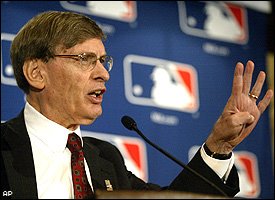
An ESPN News anchor quoted a report in the Chicago Tribune that Major League Baseball was considering a suspension for Barry Bonds. They claim their information came from this Selig press conference. Obviously, they're either lying or can't read. Look at it for yourself.
COMMISSIONER BUD SELIG: Chuck Armstrong, the President of the Mariners walked in. I told him to get out of the line of fire. I didn't want him to get hit. Good afternoon. I guess I'll preempt all the questions you want to ask on the story of the last 24 hours. I will review all the material that's relative in every way. And obviously, we've only seen parts of things. And the book itself doesn't come out until the end of the month, but we'll review everything that there is to look at. And at some appropriate time, I'll have further comment. But I don't have any further comment at this point. So we'll talk about all the other subjects you'd like to talk about today. I'll be very happy to do so.
Q: Barry Bloom from MLB.com.
COMMISSIONER: Believe me, an introduction is not necessary. (Laughter) But thank you for asking.
Q. Are we talking about an investigation or are we just talking about --
COMMISSIONER: I just said I would review all of the information. I was very careful, Barry, to say exactly what I said, and that's exactly what I mean. Ken?
Q. Bud, they want us to introduce ourselves is the only reason --
COMMISSIONER: No, I understand. He follows me around. I really -- I hate to say this to you, but my wife might get concerned after a while. All right, Ken. Go ahead.
Q. You spend more time with me than her.
COMMISSIONER: That's true.
Q. Bob Dupuy was quoted by Bloomberg News as saying you were going to meet with Barry Bonds at some point; is that accurate?
COMMISSIONER: I don't have any plans to do that now, Ken. But I just -- I meant what I said, you know. This story, in the form it has, just happened, and so I want to be very careful here as to how I respond. I know Bob said that, and I'm not saying it will or won't happen. But I don't have any plans at this moment.
Q. You seem to make news every time you come out here. When we were up at --
COMMISSIONER: Believe me, I -- today if I had my choice, I would have gone to have a root canal job. (Laughter.)
Q. On that line, when we were talking about the initial steroid developments at the Honors meeting, you made the comment that this period of time we've talked about may be called the steroid era, like the dead ball era. Is that something that you think is a genuine concern when people look back at what happened over the last 10 years?
COMMISSIONER: Let me try to review. I've spent a lot of time thinking about this, not only in the last 48 hours, but come on. For whatever one wants to say, from 1998 on, we've come, as a sport, a long way. We have a minor league program that's entered it's sixth year, I believe. We got drug testing for the first time in our history. At other times, as I said, back in the '80s, when there was a very significant problem, cocaine problem, couldn't get any testing. People have been critical of the plan, but it led -- the first plan we got led to a second plan, which the Players Association agreed to to their everlasting credit, agreed to it and didn't have to. And then, of course, last year from March 17th on to where we are today, I believe we have the toughest testing program in American sports. I can only deal with the present and the future. There's a lot of people who already have significantly different observations about what's happened, even the latest things. And, you know, I have to -- I'll have to let nature takes its course in that regard. I said a year or two ago, and I'll say again here today, I can only do what's in the present and the future's best term interest for our sport. Nobody can turn the clock back. And I have said publicly many times, and I'll say it again, that for the most part, our players did not engage in steroid use. We have allowed a fair amount of test results that show that, even the first test result. So I think it's unfair to stigmatize, if you will, if that's the word, everybody with that kind of usage.
Q.You've addressed this in the past, but would you do it one more time. Give your view on the idea that a lot have people suggested you should do something about Bonds' records or the records of any other players who have -- who are suspected or have used performance-enhancing substances.
COMMISSIONER: I will. I'm sensitive about that because, look, I've had people say, you know, if Judge Landis were still alive, this is what he would do. Well, the fact of the matter is that for the most part, I'm very careful what I say here, so please listen, we have no empirical data before 2003. I've heard a lot of people make observations. I think, Marie, I've even used the term McCarthyism in some great regard about people who without much evidence other than what they believe is anecdotal evidence say, well, this person did it or that person did it. And I'm going to be very sensitive about all that because after all, you're playing with people's lives and their reputations, and you ought to be very careful. All of us ought to be careful. The commissioner certainly is going to be careful. It doesn't mean I don't have interest. I've spent more time talking, as I've told all of you, to doctors, trainers, players from different generations. I've had a lot of conversations with a lot of people, more than anybody will ever know. So for anybody to suggest that I haven't taken this seriously is not only wrong, but is making another observation, which is both unfortunate and unfair. And when I look back on the '90s, maybe even the '80s, I've talked to a lot of players including a significant number of players that played for me. Nobody commented to me at the time. A lot of general managers who I have enormous regard for are insulted when people say they knew, they turned a blind eye, this is a great thing for baseball, they made a lot of money, all of which is just sheer nonsense. But I know it makes good reading, so that's okay -- or good listening. So, it isn't a question that we are not sensitive to these concerns. I think we have done everything we could and what's evolved has been I think fair. I said to all of you, some of you disagreed, and I understood that, too, that a year ago, I told you it was an integrity issue for me. That's why we needed a tougher program. I think history has borne me out to be absolutely right, by the way, but if you'll permit me one pat on the back today because that's the only one I'll get all day from anybody. But I am proud of that fact, and of all the parties involved, the Players Association, the clubs, everybody has I think really worked hard at this and there is no lack of concern or sensitivity anywhere. A lot of things in life, you know, you wish didn't happen, but they do. I guess that's as they remind me almost on a daily basis that's why you have a commissioner. As if I needed reminding, by the way.
Q. Bud, you said you would review the material, but with what's just come out so far with the excerpts, what's been said in the last 48 hours, would you comment on the damage it's done to the game again and whether you're disturbed about the excerpts you've heard and also the timing with the World Baseball Classic?
COMMISSIONER: Look, I'm not going to comment any further because I'm in a position I think all of you understand as a commissioner that, you know, comment from me at this very, very preliminary time is just inappropriate. And I want to be very careful about that, Tom. And yesterday, as I was watching the Venezuela/Dominican game, I was just enthralled by what I was seeing, and I should have learned 40 years ago, and I do this all the time, I said what a great day this is going to be just watching. (Laughter.) That was at 12:01.
Q. Could I ask you, you said whatever you're going to call it, examination, review, investigation, whatever, can you tell us why it's important for the commissioner of baseball to do this?
COMMISSIONER: Well, because I feel that it is. And I think that given everything that's come out, I can't sit here and tell you today, well, that's fine. This is interesting. I believe, as I would do on every subject, that I felt in any way it involves the game, reflects the game, I would do this and that's what I'm doing.
Q. Will that necessarily -- I know you were asked that before. Wouldn't it necessarily involve at least some contact with Barry Bonds?
COMMISSIONER: You know, that's a judgment that I haven't made yet at this point in time.
Q. Do you like the World Classic a little better today than you did a week ago?
COMMISSIONER: I like it a lot better than the other stuff we've been talking about.
Q. How concerned are you personally about the idea regardless of who it might be, the idea of someone holding the most revered records in the sport eventually, by whatever means, being proven a cheater? How much of that, as all this steroid stuff has been unfolding in the past year or so, how much has that been a concern of yours?
COMMISSIONER: I'm not going to comment on that, Dan. You know, until all the evidence is in and until I've heard and conducted what I said I was going to do, I think it's inappropriate for me to comment, and I won't comment on it.
Q. Bud, working on that a little bit, regardless of what happens over the next month or so, how will you view Bonds this summer as he sort of steps towards these things? How will you be watching? What will your emotions be?
COMMISSIONER: You know, again, until all the facts are known, Tim, until I've really been thorough and looked at everything -- after all, he's denied, continues to deny. And so, therefore, you know, I really believe it's inappropriate for me to comment on any of that in any way, shape, form, or manner. I understand the concern of trying to pass judgment and I understand that, but I just, I'm not going to do that until we know everything there is to know. And I don't think anybody today can say that they know that, and that's why I think my comment is appropriate.
Q. Bud, Pete Rose did deny -- Pete Rose was investigated. What is the difference? Why did MLB investigate Rose and why hasn't MLB investigated Bonds? In previous years, you've said there hasn't been enough evidence on Bonds, two years ago, one year ago, most recently this spring.
COMMISSIONER: I don't want to get back into the Pete Rose thing, but there was enormous evidence that Peter Ueberroth and Bart Giammati had, John, right from the beginning. That's what prompted them to do what they did.
Q. Is there more evidence today than there was the last time you said there's not enough evidence on Barry Bonds?
COMMISSIONER: Again, I'm not in a position to make that judgment.
Q. Lastly, what will MLB do to acknowledge Bonds passing Ruth, if he does it, it could happen next month?
COMMISSIONER: Everybody's asked that before, and we'll decide that when things move forward.
Q. Bud, have you had any communication in the last 24 or 48 hours from Washington from Congress regarding the possibility of reopening the investigation that they held, and do you anticipate another trip to Capitol Hill?
COMMISSIONER: I've had no communication. I've talked to some people in Washington today who seem to be more concerned with other things frankly. But look, Tim, we went to Washington, passed the toughest steroid bill in sports, took care of amphetamines. After all, amphetamines have been around for seven decades or longer. I don't know what they called them way back then. So I think that everybody in Washington, and they've all told me this, I don't think -- we did what we had to do. Now, I was very careful what I said on what we're going to do, and I don't think anybody in Washington would disagree with this stance. The answer is I've heard from nobody.
Q. Bud, as somebody's been in this business for a long time, we journalists look at what these two respected journalists have done and the length of work and the evidence they've pointed to in terms of sources and carefully sourcing everything they did. And to some of us, it may seem -- I'm right here -- you're giving kind of a skate to that and treating this like any other book that's come out, but this is an exhaustive piece of research. It's obvious. Are you planning to, A, get an advanced copy of the book, B, talk to the people who wrote it and what they came to? And don't you give this book a little more weighty evidence than just something that flies out on paperback at some point?
COMMISSIONER: Well, I didn't infer that at all. I said we would review the entire situation. I meant review the entire situation. The book's not out yet, and certainly I'm sure that all of us will read the book.
Q. Who is your point person on the review and does Bonds remain on the active roster during the review?
COMMISSIONER: Well, the point person will be people in our office, Jerry. I've talked to obviously Bob Dupuy and John McHale and Rob Manfred, Jimmy Lee Solomon. There will be a lot of people as they do on most subjects.
Q. Does he remain on the roster (inaudible)?
COMMISSIONER: Certainly does.
Q. What are you able -- as commissioner, what power do you have to do something if you find certain -- make certain findings in your examination?
COMMISSIONER: Determine that at the appropriate time. Of all the concerns I have today, that's the least concern.
Q. Can you explain, as commissioner, do you have a total power? I've never understood exactly what power the commissioner has.
COMMISSIONER: Neither do a lot of other people. (Laughter.)
THE MODERATOR: Just a couple more questions.
Q. What have you seen David Wells' comments?
COMMISSIONER: I have.
Q. What's your reaction?
COMMISSIONER: I have no reaction.
Q. No comment?
COMMISSIONER: None.
Q. Are you going to --
COMMISSIONER: I have no reaction, Barry.
THE MODERATOR: Any others? All right. Thank you.
Wednesday, March 08, 2006
Barry Bonds' Lawyer Issues Statement on San Francisco Chronicle Book Charges
My client, Barry Bonds, has not read the Sports Illustrated article and does not intend to. Furthermore, he does not intend to read the book from which the article is excerpted.
Barry regards this as an unfortunate distraction to his friends and teammates at the San Francisco Giants, and to the good name and the great players in Major League Baseball.
The San Francisco Chronicle, after announcing that it had (illegally) obtained Barry's grand jury testimony, previously published questions asked of him while under oath, and his answers. Many of the assertions raised in this article were also previously mentioned. To that extent, this is simply a duplication of previously reported information.
Although most of the authors' supposed 200 or so "sources" for this book remain anonymous, we know and understand that one of the most prominent sources is a woman who previously attempted to extort Barry for money, and who, after that failed, told Geraldo Rivera that she never saw Barry take illegal or performance-enhancing drugs, but explained that her source of knowledge supposedly came from conversations she had with him -- conversations she intended to report in her soon-to-be published (and yet to be published) book.
Some of the other prominent but "anonymous sources" surfaced during the BALCO investigation, and we understand that reporting their identity would also expose their lack of credibility.
The exploitation of Barry's good name and these attempts to eviscerate his sensational accomplishments in all phases of the game of baseball (throughout high school and college, as well as 20 years playing professionally) may make those responsible wealthy, but in the end, they need to live with themselves. Beyond this -- Barry has no further comment now nor in the foreseeable future. His focus remains on staying healthy, playing baseball and doing everything he can to help the Giants play in the World Series seven months from now.
Barry regards this as an unfortunate distraction to his friends and teammates at the San Francisco Giants, and to the good name and the great players in Major League Baseball.
The San Francisco Chronicle, after announcing that it had (illegally) obtained Barry's grand jury testimony, previously published questions asked of him while under oath, and his answers. Many of the assertions raised in this article were also previously mentioned. To that extent, this is simply a duplication of previously reported information.
Although most of the authors' supposed 200 or so "sources" for this book remain anonymous, we know and understand that one of the most prominent sources is a woman who previously attempted to extort Barry for money, and who, after that failed, told Geraldo Rivera that she never saw Barry take illegal or performance-enhancing drugs, but explained that her source of knowledge supposedly came from conversations she had with him -- conversations she intended to report in her soon-to-be published (and yet to be published) book.
Some of the other prominent but "anonymous sources" surfaced during the BALCO investigation, and we understand that reporting their identity would also expose their lack of credibility.
The exploitation of Barry's good name and these attempts to eviscerate his sensational accomplishments in all phases of the game of baseball (throughout high school and college, as well as 20 years playing professionally) may make those responsible wealthy, but in the end, they need to live with themselves. Beyond this -- Barry has no further comment now nor in the foreseeable future. His focus remains on staying healthy, playing baseball and doing everything he can to help the Giants play in the World Series seven months from now.
Barry Bonds: 63 Percent Polled on ESPN.com Will Not Read The New Barry Bonds Book
I just heard this on ESPN News. While there's a new poll at ESPN.com, the old one reportedly asked if fans would read the San Francisco Chroncle reporter's book "Game of Shadows." 63 Percent said "NO."
If I were Barry, I'd sue the SF Chron for defamation
If I were Barry, I'd sue the SF Chron for defamation
Tuesday, March 07, 2006
San Francisco Chronicle Lynches SF Giants' Barry Bonds, Film at 11
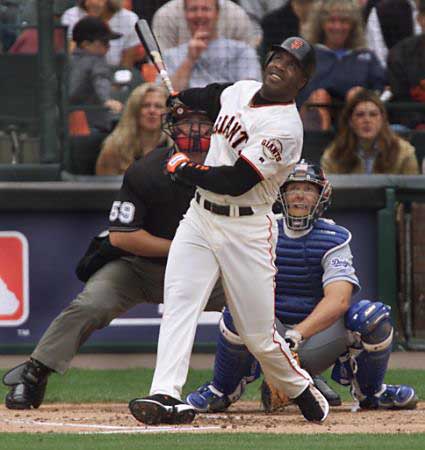
Repeat after me: Barry Bonds said "I never knowingly took a banned substance" ; Barry Bonds said "I never knowingly took a banned substance." ; Barry Bonds said "I never knowingly took a banned substance."
Ok. Now, how many times does he have to say that? Apparently not enough for the San Francisco Chronicle. In a book to be released on March 21st, two Chron writers, Mark Fainaru-Wada and Lance Williams, claim that 200 sources "saw" Bonds take a banned substance, a form of steroid starting in 1998.
The San Francisco Bay Area sports media -- well populated with haters of the San Francisco Giants' premier slugger -- was quick to jump on the Chron's story, so quick that their brains shut off in the process. The people hot to lock up Barry Bonds apparently scored "six" on their Wonderlic tests -- and that exam applies more to what journalists do than the tasks of NFL quarterbacks.
But I digress.
The San Francisco Chronicle, in its lustful zeal to lynch a man that some Bay Area media types have branded as "arrogant" and basically a combination of adjectives that add up to "Uppity Negro," didn't even bother to use the term "allegedly." Nope. They just plain out and out wrote this:
Barry Bonds began using steroids after the 1998 baseball season and came to rely on a wide variety of performance-enhancing drugs over the next several years, according to a book written by two Chronicle reporters and excerpted in this week's Sports Illustrated.
The impication of this opening paragraph of today's Chronicle article is that everything Barry took was not legal at the time. Moreover, the Chronicle drunkenly uses the term "performance-enhancing drugs" as if that's a bad thing. Hey, in that case, you'd better lock me up for the four vitamin pills I took today.
I swear it's work like this that makes me wonder if some writers take the sauces before they write, rather than after they've written. And regardless of what the writer tells you, the sauce is not a performance-enhancing drug, but it can certainly cause one to write that Barry Bonds was knowingly using them, when they should have used more careful prose.
Here are the facts.
In 2002, San Diego Padres Ken Caminiti told Sports Illustrated that in 1996, not only was he using steroids, but half the players in Major League Baseball. Apparently, Bonds, who reportedly started using steroids in 1998, got the memo two years late, but even then the substances that were being provided were not illegal.
Indeed, it wasn't until 2004 that Major League Baseball placed a ban on the use of any drug that could be a steroid.
But the point is that -- repeat after me -- Barry Bonds said "I never knowingly took a banned substance." Again, Barry Bonds said "I never knowingly took a banned substance."
Are you listening?
This entire affair reads more like an attempt to defame Barry Bonds. I mean, why do I need to know that the drugs Bonds took which he did not know to be illegal have caused him to suffer sexual dysfunction and lead to his supposedly terrible behavior?
In other words, it's really important I know the brother's pissed cause he can't get it up. How in the heck do they know that, and why should I be aware of this news? It reads as if the Chron's trying to help Bonds' mistress stick it to him, and I'm not talking about a needle, either.
What's the point? If it's meaness, then Phil Bronstein's boys have hit the mark.
Look, I'm sure Barry was no different than "half the players in Major League Baseball" but where Mark McQuire gets away with a clean image (drug use allegations don't stick to him, even though Jose Canseco says McQuire used them), here comes the Chronicle to make sure dirt's kicked in Barry's face.
I have a feeling egg's going to be on the face of the Chronicle. Williams says that "I think it's important for baseball to corral performance-enhancing drugs and not tolerate them, because the tolerance for those drugs will inevitably seep down into the colleges and the prep programs. We're already seeing it," in response to why this story's important. That's a load of bull; the story's important because it's the latest bazooka they're using to embarrass Barry Bonds.
Look, Barry's not perfect. Fine. But he's a great baseball player. As far as I'm concerned, and other fans too, I'll still root for Barry, and pray that the San Francisco Chronicle gets a perfomance-enhanced kick in the collective ass.
Shocking: Kirby Puckett Passes Away at 47 Years of Age
One day. One day after suffering a stroke, Minnesota Twins star Kirby Puckett passed away. This is the rest of the sad, sad story. He was just 47 years old. God called him too early, and on the eve of his wedding.

MINNEAPOLIS (AP) -- Kirby Puckett didn't need much time to make a big impact. Those who felt it, near and far, can only wish he had stayed around longer.
In his 12-year career, Puckett won six Gold Gloves, the 1989 batting title and two championship rings.
The bubbly Hall of Famer with the boyish enthusiasm for baseball, who led the Minnesota Twins to two World Series titles before his career was cut short by glaucoma, died Monday after a stroke. He was 45.
"He was revered throughout the country and will be remembered wherever the game is played," commissioner Bud Selig said. "Kirby was taken from us much too soon -- and too quickly."
Indeed, Puckett was the second-youngest person to die having already been enshrined in Cooperstown, Hall of Fame spokesman Jeff Idelson said. Only Lou Gehrig, at 37, was younger.
Stricken early Sunday at his Arizona home, Puckett died at St. Joseph's Hospital and Medical Center in Phoenix, where friends and family had gathered. Puckett, who was divorced, is survived by his children, Catherine and Kirby Jr. He was engaged to be married to his fiancée, Jodi Olson, this summer. Funeral arrangements were pending.
Puckett's post-retirement weight gain over the past decade had concerned friends and family, who were saddened but not shocked by his stroke.
"It's a tough thing to see a guy go through something like that and come to this extent," former teammate Kent Hrbek said.
Puckett led the Twins to championships in 1987 and 1991 after breaking into the majors in 1984. With a career batting average of .318, six Gold Gloves and 10 All-Star game appearances, Puckett woke up one morning during spring training in 1996 with blindness in his right eye, a condition that forced him to retire.
"That's what really hurt him bad, when he was forced out of the game," Hrbek said. "I don't know if he ever recovered from it."
A makeshift memorial began to form Monday night outside the Metrodome, with a handful of bouquets, caps and candles laid on the sidewalk.
"I grew up in center field yelling down on him. It's just not right," said fan Daniel Boche, who knelt down to pay his respects. "He was my idol growing up."
"It's tough to take," Twins general manager Terry Ryan said from the team's spring training camp in Fort Myers, Fla. "He had some faults, we knew that, but when all was said and done he would treat you as well as he would anyone else. No matter who you were.
"When you're around him, he makes you feel pretty good about yourself. He can make you laugh. He can do a lot of things that can light up a room. He's a beauty," Ryan said.
Though he steadfastly refused to speak pessimistically about the premature end to his career, Puckett's personal life began to deteriorate after that.
Shortly after his induction to Cooperstown, his then-wife, Tonya, accused him of threatening to kill her during an argument -- he denied it -- and described to police a history of violence and infidelity. In 2003, he was cleared of all charges from an alleged sexual assault of a woman at a suburban Twin Cities restaurant and kept a low profile after the trial, eventually moving to Arizona.
He stopped attending spring training as a special instructor in 2002.
Puckett was elected to the Hall of Fame in his first year of eligibility in 2001, and his plaque praised his "ever-present smile and infectious exuberance."
He spent his entire career with Minnesota.
"I wore one uniform in my career, and I'm proud to say that," Puckett once said. "As a kid growing up in Chicago, people thought I'd never do anything. I've always tried to play the game the right way. I thought I did pretty good with the talent that I have."
Puckett's signature performance came in Game 6 of the 1991 World Series against Atlanta. After telling anyone who would listen before the game that he would lead the Twins to victory that night at the Metrodome, he made a leaping catch against the fence and then hit a game-ending homer in the 11th inning to force a seventh game.
The next night, Minnesota's Jack Morris went all 10 innings to outlast John Smoltz and pitch the Twins to a 1-0 win for their second championship in five years.
"If we had to lose and if one person basically was the reason -- you never want to lose -- but you didn't mind it being Kirby Puckett. When he made the catch and when he hit the home run you could tell the whole thing had turned," Smoltz said.
"His name just seemed to be synonymous with being a superstar," the Braves pitcher added. "It's not supposed to happen like this."
Hall of Fame catcher Carlton Fisk echoed Smoltz's sentiment.
"There was no player I enjoyed playing against more than Kirby. He brought such joy to the game. He elevated the play of everyone around him," Fisk said in a statement to the Hall.
Puckett's birthdate was frequently listed as March 14, 1961, but recent research by the Hall of Fame indicated he was born a year earlier.
The youngest of nine children born into poverty in a Chicago housing project, Puckett was drafted by the Twins in 1982 and became a regular just two years later. He got four hits in his first major league start and finished with 2,304 in only 12 seasons.
Though his power numbers, 207 home runs and 1,085 RBI, weren't exceptional, Puckett won an AL batting title in 1989 and was considered one of the best all-around players of his era. His esteem and enthusiasm for the game factored into his Hall of Fame election as much as his statistics and championship rings.
He made his mark on baseball's biggest stage, leading heavy underdog Minnesota to a seven-game victory over St. Louis in 1987 and then doing the same against Atlanta in one of the most thrilling Series in history.
"There are a lot of great players in this game, but only one Kirby," pitcher Rick Aguilera said when Puckett announced his retirement. "It was his character that meant more to his teammates. He brought a great feeling to the clubhouse, the plane, everywhere."
Puckett's best year was 1988, when he batted .356 with 24 home runs, 42 doubles and 121 RBI. A contact hitter and stolen base threat in the minors who hit a total of four homers in his first two major league seasons, Puckett developed a power stroke in 1986 and went deep a career-best 31 times.
He became a fixture in the third spot in Minnesota's lineup, a free-swinging outfielder with a strong arm and a flair for nifty catches despite his 220-pound frame that made him look more like a fullback. The man known simply as "Puck" was immensely popular.
Fans loved his style, especially the high leg kick he used as he prepared to swing. Public address announcer Bob Casey, who became a close friend, introduced him with vigor before every at-bat, "KIR-beeeeeeeeee PUCK-it."
Hit by a pitch that broke his jaw on his last at-bat of the 1995 season, Puckett woke up one morning the following spring and couldn't see out of his right eye. It was eventually diagnosed as glaucoma, forcing him to call it quits that July.
Ryan said he had an "empty" feeling that day, much like the mood around the organization Monday.
"His time came way too early," Ryan said.
MINNEAPOLIS (AP) -- Kirby Puckett didn't need much time to make a big impact. Those who felt it, near and far, can only wish he had stayed around longer.
In his 12-year career, Puckett won six Gold Gloves, the 1989 batting title and two championship rings.
The bubbly Hall of Famer with the boyish enthusiasm for baseball, who led the Minnesota Twins to two World Series titles before his career was cut short by glaucoma, died Monday after a stroke. He was 45.
"He was revered throughout the country and will be remembered wherever the game is played," commissioner Bud Selig said. "Kirby was taken from us much too soon -- and too quickly."
Indeed, Puckett was the second-youngest person to die having already been enshrined in Cooperstown, Hall of Fame spokesman Jeff Idelson said. Only Lou Gehrig, at 37, was younger.
Stricken early Sunday at his Arizona home, Puckett died at St. Joseph's Hospital and Medical Center in Phoenix, where friends and family had gathered. Puckett, who was divorced, is survived by his children, Catherine and Kirby Jr. He was engaged to be married to his fiancée, Jodi Olson, this summer. Funeral arrangements were pending.
Puckett's post-retirement weight gain over the past decade had concerned friends and family, who were saddened but not shocked by his stroke.
"It's a tough thing to see a guy go through something like that and come to this extent," former teammate Kent Hrbek said.
Puckett led the Twins to championships in 1987 and 1991 after breaking into the majors in 1984. With a career batting average of .318, six Gold Gloves and 10 All-Star game appearances, Puckett woke up one morning during spring training in 1996 with blindness in his right eye, a condition that forced him to retire.
"That's what really hurt him bad, when he was forced out of the game," Hrbek said. "I don't know if he ever recovered from it."
A makeshift memorial began to form Monday night outside the Metrodome, with a handful of bouquets, caps and candles laid on the sidewalk.
"I grew up in center field yelling down on him. It's just not right," said fan Daniel Boche, who knelt down to pay his respects. "He was my idol growing up."
"It's tough to take," Twins general manager Terry Ryan said from the team's spring training camp in Fort Myers, Fla. "He had some faults, we knew that, but when all was said and done he would treat you as well as he would anyone else. No matter who you were.
"When you're around him, he makes you feel pretty good about yourself. He can make you laugh. He can do a lot of things that can light up a room. He's a beauty," Ryan said.
Though he steadfastly refused to speak pessimistically about the premature end to his career, Puckett's personal life began to deteriorate after that.
Shortly after his induction to Cooperstown, his then-wife, Tonya, accused him of threatening to kill her during an argument -- he denied it -- and described to police a history of violence and infidelity. In 2003, he was cleared of all charges from an alleged sexual assault of a woman at a suburban Twin Cities restaurant and kept a low profile after the trial, eventually moving to Arizona.
He stopped attending spring training as a special instructor in 2002.
Puckett was elected to the Hall of Fame in his first year of eligibility in 2001, and his plaque praised his "ever-present smile and infectious exuberance."
He spent his entire career with Minnesota.
"I wore one uniform in my career, and I'm proud to say that," Puckett once said. "As a kid growing up in Chicago, people thought I'd never do anything. I've always tried to play the game the right way. I thought I did pretty good with the talent that I have."
Puckett's signature performance came in Game 6 of the 1991 World Series against Atlanta. After telling anyone who would listen before the game that he would lead the Twins to victory that night at the Metrodome, he made a leaping catch against the fence and then hit a game-ending homer in the 11th inning to force a seventh game.
The next night, Minnesota's Jack Morris went all 10 innings to outlast John Smoltz and pitch the Twins to a 1-0 win for their second championship in five years.
"If we had to lose and if one person basically was the reason -- you never want to lose -- but you didn't mind it being Kirby Puckett. When he made the catch and when he hit the home run you could tell the whole thing had turned," Smoltz said.
"His name just seemed to be synonymous with being a superstar," the Braves pitcher added. "It's not supposed to happen like this."
Hall of Fame catcher Carlton Fisk echoed Smoltz's sentiment.
"There was no player I enjoyed playing against more than Kirby. He brought such joy to the game. He elevated the play of everyone around him," Fisk said in a statement to the Hall.
Puckett's birthdate was frequently listed as March 14, 1961, but recent research by the Hall of Fame indicated he was born a year earlier.
The youngest of nine children born into poverty in a Chicago housing project, Puckett was drafted by the Twins in 1982 and became a regular just two years later. He got four hits in his first major league start and finished with 2,304 in only 12 seasons.
Though his power numbers, 207 home runs and 1,085 RBI, weren't exceptional, Puckett won an AL batting title in 1989 and was considered one of the best all-around players of his era. His esteem and enthusiasm for the game factored into his Hall of Fame election as much as his statistics and championship rings.
He made his mark on baseball's biggest stage, leading heavy underdog Minnesota to a seven-game victory over St. Louis in 1987 and then doing the same against Atlanta in one of the most thrilling Series in history.
"There are a lot of great players in this game, but only one Kirby," pitcher Rick Aguilera said when Puckett announced his retirement. "It was his character that meant more to his teammates. He brought a great feeling to the clubhouse, the plane, everywhere."
Puckett's best year was 1988, when he batted .356 with 24 home runs, 42 doubles and 121 RBI. A contact hitter and stolen base threat in the minors who hit a total of four homers in his first two major league seasons, Puckett developed a power stroke in 1986 and went deep a career-best 31 times.
He became a fixture in the third spot in Minnesota's lineup, a free-swinging outfielder with a strong arm and a flair for nifty catches despite his 220-pound frame that made him look more like a fullback. The man known simply as "Puck" was immensely popular.
Fans loved his style, especially the high leg kick he used as he prepared to swing. Public address announcer Bob Casey, who became a close friend, introduced him with vigor before every at-bat, "KIR-beeeeeeeeee PUCK-it."
Hit by a pitch that broke his jaw on his last at-bat of the 1995 season, Puckett woke up one morning the following spring and couldn't see out of his right eye. It was eventually diagnosed as glaucoma, forcing him to call it quits that July.
Ryan said he had an "empty" feeling that day, much like the mood around the organization Monday.
"His time came way too early," Ryan said.
Monday, March 06, 2006
Boston Red Sox Pitcher David Wells , Pissed Off With "Lack of Privacy" in Boston, Now Will Remain and Retire, Instead of Seeking Trade
By Howard Ulman, The Associated Press
FORT MYERS, Fla. -- Boston Red Sox left-hander David Wells rescinded his trade request and said Sunday there was a "99.9" percent chance he would retire after the upcoming season.
He said he told Boston general manager Theo Epstein of his decision on Saturday. Wells had requested a trade so he could be closer to his family in San Diego. He also disliked the lack of privacy he had when he went out in public in Boston.
During Saturday's meeting, Wells said, Epstein told him "there are a lot of teams out there that are not interested because of the fact that there are a lot of young guys they want to look at."
The 42-year-old Wells is coming off surgery on his right knee, lessening the likelihood that a team would want him before he proves he's healthy. He said his first exhibition start for the Red Sox could take place on March 13 or 14.
Washington Nationals Get Stadium Lease Signed By MLB
By Joseph White, The Associated Press
WASHINGTON — Major League Baseball took a major step Sunday toward resolving an impasse over a home for the Washington Nationals, signing a lease for a new ballpark.
One day before the Monday deadline imposed by the District of Columbia Council, baseball signed the lease approved by the Council last month. The lease calls for a ballpark to be built along the Anacostia River, south of the Capitol, with a provision capping the city's spending for the project at $611 million.
Baseball, which will not select a new owner for the team until a lease is in place, had expressed concern over the cap, which altered the original 2004 agreement that brought the team from Montreal last season. In particular, baseball was concerned about a scenario in which the team's future owners could be forced to pay cost overruns. The alternatives for baseball would have been to ask for binding arbitration or search for a new city.
"We have worked very hard to accommodate the requests from the mayor and the Council that changed the terms of the agreement that brought the Expos to Washington," baseball chief operating officer Bob DuPuy said in a statement. "Because we believe in the future of baseball in the nation's capital, we have signed a lease that honors the 2004 agreement, while conforming to the emergency legislation that the Council passed last month."
DuPuy said the lease will go into effect if the Council agrees to several provisions, including an agreement that the city not enact any legislation that violates the terms of the lease. Other provisions deal with the issuing of bonds that pay for construction and how those bonds will be funded.
The Council will study the provisions over the next 48 hours.
"I don't see anything that could be a deal-breaker," Councilman Jack Evans said. "The devil is in the details, but all of that sounds like something we can move forward on."
Evans said his main concern with the provisions is that they could delay a final resolution for several week, which would further delay construction.
Council chair Linda Cropp's main concern was that the city's spending cap remained intact.
"I haven't seen the provisions yet, I've only talked to folks," Cropp said. "What they have said to me is that baseball has certified the council's legislation with the $611 million cap. If that is the case, then that's a good thing and we can move forward."
Mark Tuohey, chairman of the D.C. Sports and Entertainment Commission and a lead negotiator for the city, said he saw nothing in the provisions that would scuttle the lease.
Vince Morris, a spokesman for Mayor Anthony A. Williams, said the additional provisions "should be OK," although city leaders would spend Sunday night and Monday examining them.
"We're delighted, and I'm betting millions of Nationals fans are too," Morris said. "This clears one of the last hurdles in the process and gets us ready to finally break ground on a ballpark that gives the Nationals a new home and sparks an exciting economic revival in southeast."
The Expos/Nationals were bought in 2002 by the other 29 major league teams and operate on a limited budget. Baseball and the city have been negotiating the lease for more than a year, and commissioner Bud Selig has delayed selecting a new owner because of the lease dispute.
The Nationals will continue to play at RFK Stadium until the new stadium opens.
WASHINGTON — Major League Baseball took a major step Sunday toward resolving an impasse over a home for the Washington Nationals, signing a lease for a new ballpark.
One day before the Monday deadline imposed by the District of Columbia Council, baseball signed the lease approved by the Council last month. The lease calls for a ballpark to be built along the Anacostia River, south of the Capitol, with a provision capping the city's spending for the project at $611 million.
Baseball, which will not select a new owner for the team until a lease is in place, had expressed concern over the cap, which altered the original 2004 agreement that brought the team from Montreal last season. In particular, baseball was concerned about a scenario in which the team's future owners could be forced to pay cost overruns. The alternatives for baseball would have been to ask for binding arbitration or search for a new city.
"We have worked very hard to accommodate the requests from the mayor and the Council that changed the terms of the agreement that brought the Expos to Washington," baseball chief operating officer Bob DuPuy said in a statement. "Because we believe in the future of baseball in the nation's capital, we have signed a lease that honors the 2004 agreement, while conforming to the emergency legislation that the Council passed last month."
DuPuy said the lease will go into effect if the Council agrees to several provisions, including an agreement that the city not enact any legislation that violates the terms of the lease. Other provisions deal with the issuing of bonds that pay for construction and how those bonds will be funded.
The Council will study the provisions over the next 48 hours.
"I don't see anything that could be a deal-breaker," Councilman Jack Evans said. "The devil is in the details, but all of that sounds like something we can move forward on."
Evans said his main concern with the provisions is that they could delay a final resolution for several week, which would further delay construction.
Council chair Linda Cropp's main concern was that the city's spending cap remained intact.
"I haven't seen the provisions yet, I've only talked to folks," Cropp said. "What they have said to me is that baseball has certified the council's legislation with the $611 million cap. If that is the case, then that's a good thing and we can move forward."
Mark Tuohey, chairman of the D.C. Sports and Entertainment Commission and a lead negotiator for the city, said he saw nothing in the provisions that would scuttle the lease.
Vince Morris, a spokesman for Mayor Anthony A. Williams, said the additional provisions "should be OK," although city leaders would spend Sunday night and Monday examining them.
"We're delighted, and I'm betting millions of Nationals fans are too," Morris said. "This clears one of the last hurdles in the process and gets us ready to finally break ground on a ballpark that gives the Nationals a new home and sparks an exciting economic revival in southeast."
The Expos/Nationals were bought in 2002 by the other 29 major league teams and operate on a limited budget. Baseball and the city have been negotiating the lease for more than a year, and commissioner Bud Selig has delayed selecting a new owner because of the lease dispute.
The Nationals will continue to play at RFK Stadium until the new stadium opens.
Hall of Famer Kirby Puckett in critical condition after stroke
By Jim Mone, AP
FORT MYERS, Fla. (AP) — Hall of Fame outfielder Kirby Puckett was in critical condition after having surgery for a stroke, a nursing supervisor said early Monday.
The 44-year-old former Minnesota Twins star, who led the Twins to two championships before his career was cut short by glaucoma, was stricken Sunday at his Arizona home.
Puckett had surgery at Scottsdale health care Osborn, the Twins said from their spring training camp in Fort Myers, Fla., and was later moved to St. Joseph's Hospital and Medical Center in Phoenix.
A nursing supervisor at St. Joseph's, who declined to give her full name, said Puckett was in critical condition. She did not provide additional details.
"The Minnesota Twins and Major League Baseball ask fans to keep Kirby and his family in their thoughts and prayers," the team said earlier in a statement.
Ron Shapiro, who was Puckett's agent, said he had been in contact with Puckett's family Sunday.
"We're all praying for his recovery," Shapiro said.
Twins center fielder Torii Hunter sat out Minnesota's exhibition game against the Red Sox after learning of Puckett's stroke.
After the game, team officials said they didn't immediately have any further information on Puckett's condition.
"The doctors said that if he has good luck, he'll be all right. You have to keep the faith," former manager Tom Kelly said.
Said manager Ron Gardenhire: "Our hearts and our prayers are all with Puck. We know it's a tough situation out there."
Puckett, who broke in with Minnesota in 1984, had a career batting average of .318 and carried the Twins to World Series titles in 1987 and 1991.
Glaucoma forced the Gold Glove center fielder and 10-time all-star to retire in 1996 after 12 seasons with the Twins when he went blind in one eye.
Three years ago, he was cleared of assault charges after being accused of groping a woman at a Twin Cities restaurant.
Puckett has maintained relationships with many people in the Twins' organization. The team tried unsuccessfully to get him to come to spring training as a special instructor this year, something he hasn't done since 2002.
Another former Twins great, Tony Oliva, a special instructor during spring training, said he has been worried about Puckett's weight.
"The last few times I saw him, he kept getting bigger and bigger and bigger," Oliva said. "And we worried about him. I saw him about five months ago. He always tries to invite me. He says, 'Come to Arizona, and we'll play some golf.' "
Puckett is divorced and has two children.
FORT MYERS, Fla. (AP) — Hall of Fame outfielder Kirby Puckett was in critical condition after having surgery for a stroke, a nursing supervisor said early Monday.
The 44-year-old former Minnesota Twins star, who led the Twins to two championships before his career was cut short by glaucoma, was stricken Sunday at his Arizona home.
Puckett had surgery at Scottsdale health care Osborn, the Twins said from their spring training camp in Fort Myers, Fla., and was later moved to St. Joseph's Hospital and Medical Center in Phoenix.
A nursing supervisor at St. Joseph's, who declined to give her full name, said Puckett was in critical condition. She did not provide additional details.
"The Minnesota Twins and Major League Baseball ask fans to keep Kirby and his family in their thoughts and prayers," the team said earlier in a statement.
Ron Shapiro, who was Puckett's agent, said he had been in contact with Puckett's family Sunday.
"We're all praying for his recovery," Shapiro said.
Twins center fielder Torii Hunter sat out Minnesota's exhibition game against the Red Sox after learning of Puckett's stroke.
After the game, team officials said they didn't immediately have any further information on Puckett's condition.
"The doctors said that if he has good luck, he'll be all right. You have to keep the faith," former manager Tom Kelly said.
Said manager Ron Gardenhire: "Our hearts and our prayers are all with Puck. We know it's a tough situation out there."
Puckett, who broke in with Minnesota in 1984, had a career batting average of .318 and carried the Twins to World Series titles in 1987 and 1991.
Glaucoma forced the Gold Glove center fielder and 10-time all-star to retire in 1996 after 12 seasons with the Twins when he went blind in one eye.
Three years ago, he was cleared of assault charges after being accused of groping a woman at a Twin Cities restaurant.
Puckett has maintained relationships with many people in the Twins' organization. The team tried unsuccessfully to get him to come to spring training as a special instructor this year, something he hasn't done since 2002.
Another former Twins great, Tony Oliva, a special instructor during spring training, said he has been worried about Puckett's weight.
"The last few times I saw him, he kept getting bigger and bigger and bigger," Oliva said. "And we worried about him. I saw him about five months ago. He always tries to invite me. He says, 'Come to Arizona, and we'll play some golf.' "
Puckett is divorced and has two children.
Thursday, February 23, 2006
Yankees Steinbrenner Predicts - Or Is It Orders - World Series Title
(For Yankeees tickets, click on the title of this post.)
TAMPA, Fla. -- Welcome to "The Spring of George" at Legends Field.
Yankees owner George Steinbrenner, eager to bring a trophy back to New York and excited about the acquisition of Johnny Damon, predicted on Wednesday that this year's Yankees will win the franchise's first World Series title since 2000.
"It's been a while; we haven't won it," said Steinbrenner, who stopped to speak to TV and radio reporters. "We're going to win it this year. We're going after them this year."
The statements came as Steinbrenner, who has been more visible than usual during the first week of Spring Training, paid a visit to manager Joe Torre, parking himself on Torre's couch while the manager met with reporters.
Torre and Steinbrenner's icy relationship from last season has been well documented, and the manager made a point to address it in October as he decided whether to return for an 11th season with the Yankees.
The two men have already spoken several times this spring, so Wednesday's visit wasn't out of the ordinary, other than its timing.
"I can't do much to teach him anything," Steinbrenner said of his visits with Torre, "but I'm just there [for Torre] to know he's got my support."
Steinbrenner even muscled his way into Torre's interview session, injecting some laughter into the room. Torre was asked about the Yankees' pursuit of Damon after the 2001 season, when Jason Giambi expressed his desire to see his former Oakland teammate join him in the Bronx.
"I remember when we signed Jason, he said, 'Johnny Damon is out there,' " Torre said. "But he took all the money, so we couldn't do anything."
The words were barely out of Torre's mouth when Steinbrenner inserted his two cents into the conversation.
"You got some, didn't you?" Steinbrenner said.
"Thank you, sir," said a smiling Torre.
Mark Feinsand is a reporter for MLB.com. This story was not subject to the approval of Major League Baseball or its clubs.
Wednesday, February 22, 2006
Carl Everett expects to win with Seattle Mariners
By GREGG BELL
AP SPORTS WRITER
PEORIA, Ariz. -- He hadn't even started his first Mariners workout, and already Carl Everett was spicing up a bland Seattle spring training.
By 8 a.m. Tuesday, minutes after arriving at his new clubhouse, Everett was whooping and churning out jokes. He teased 39-year-old pitcher Dave Burba for looking like the goody-goody player depicted on the league's posted notice on the proper way to wear a uniform.
Later, the Mariners' new designated hitter explained why he bought two weeks of spring training lunches for his Montreal teammates in 2004. He paid for catered hot food over the clubhouse cold cuts, because "when you get turkey, you get the whole turkey. Legs, hips, rear end. Everything."
But there was nothing about dinosaurs. Not yet, anyway.
"That's dude's crazy, man," said outfielder Matt Lawton, a fellow offseason Seattle import and locker neighbor who spent most of his morning at Everett's side. "Good luck with HIM."
On the field, trainers called the players to stretch before for the first full Seattle practice. Everett was using nail clippers to trim his fingernails.
Everett later pantomimed punches into the stomach of new hitting coach Jeff Pentland. Three times, he clowned with a television cameraman. He bellowed cackling, drawn out laughs at Richie Sexson and Adrian Beltre around the batting cage.
The man infamous for once head-butting an umpire, spitting at and grabbing his crotch at Seattle pitcher Jamie Moyer after a home run and claiming dinosaurs never existed had landed with laughs onto his eighth team in 11 major-league seasons.
"Eight teams doesn't bother me," the 34-year-old former Marlin, Met, Astro, Red Sox, Ranger, Expo and White Sox said. "That means I'm wanted."
The Mariners, desperate for a left-handed power hitter, wanted him enough to pay the switch-hitter $3.4 million this season. Seattle also has a club option for 2007.
Everett earned $4 million last season with the World Series champion White Sox. He played in 135 games and batted .251 with 23 home runs and 87 RBIs.
It was the fourth time in his 11-year career he hit at least 20 home runs and drove in at least 80, yet Chicago declined its 2006 option.
Seattle then leaped for a potential spark for its complacent clubhouse and an even more inert offense.
"I heard this team was lax and laid back," Everett said. "I find they are very humorous and willing to play baseball - so far.
"The tone for me right now is it's going to be a great year."
Everett's first-day tone surprised some Mariners.
"Actually, being with him today, he was one of the nicest guys I've ever met," said Lawton, who has never played with Everett. "He's going to be great for our clubhouse, keeping guys loose.
"You see some many guys with the label 'Time bomb' and they are quiet, like they are about to explode. He was great."
Hold on, Matt. Everett warned those "time bomb" moments may still be coming.
"You're going to find when I'm not smiling, stay away from me," Everett said.
A hearty chuckle failed to hide his seriousness.
"I don't know what my reputation is. I've heard so much from so many different people," he said. "And, actually, I really don't care. But the guys in the clubhouse, they know who I am. They are around me more than anybody.
"I'm not a person who will let you get to know me - and that tends to offend people.
"I'm not looking for people to like me," he said. "I'm here to win."
Everett said he perceived that winning mentality to be lacking from the Mariners last year during their 69-93 season - Seattle's second consecutive 90-loss year.
"'Hope we're going to win,' that's exactly what I saw," Everett said. "It wasn't a team that went out to beat you every day."
With that, Everett rose from the picnic table he had been using as his pulpit. He then issued this ironic advisement:
"You all stay out of trouble."
AP SPORTS WRITER
PEORIA, Ariz. -- He hadn't even started his first Mariners workout, and already Carl Everett was spicing up a bland Seattle spring training.
By 8 a.m. Tuesday, minutes after arriving at his new clubhouse, Everett was whooping and churning out jokes. He teased 39-year-old pitcher Dave Burba for looking like the goody-goody player depicted on the league's posted notice on the proper way to wear a uniform.
Later, the Mariners' new designated hitter explained why he bought two weeks of spring training lunches for his Montreal teammates in 2004. He paid for catered hot food over the clubhouse cold cuts, because "when you get turkey, you get the whole turkey. Legs, hips, rear end. Everything."
But there was nothing about dinosaurs. Not yet, anyway.
"That's dude's crazy, man," said outfielder Matt Lawton, a fellow offseason Seattle import and locker neighbor who spent most of his morning at Everett's side. "Good luck with HIM."
On the field, trainers called the players to stretch before for the first full Seattle practice. Everett was using nail clippers to trim his fingernails.
Everett later pantomimed punches into the stomach of new hitting coach Jeff Pentland. Three times, he clowned with a television cameraman. He bellowed cackling, drawn out laughs at Richie Sexson and Adrian Beltre around the batting cage.
The man infamous for once head-butting an umpire, spitting at and grabbing his crotch at Seattle pitcher Jamie Moyer after a home run and claiming dinosaurs never existed had landed with laughs onto his eighth team in 11 major-league seasons.
"Eight teams doesn't bother me," the 34-year-old former Marlin, Met, Astro, Red Sox, Ranger, Expo and White Sox said. "That means I'm wanted."
The Mariners, desperate for a left-handed power hitter, wanted him enough to pay the switch-hitter $3.4 million this season. Seattle also has a club option for 2007.
Everett earned $4 million last season with the World Series champion White Sox. He played in 135 games and batted .251 with 23 home runs and 87 RBIs.
It was the fourth time in his 11-year career he hit at least 20 home runs and drove in at least 80, yet Chicago declined its 2006 option.
Seattle then leaped for a potential spark for its complacent clubhouse and an even more inert offense.
"I heard this team was lax and laid back," Everett said. "I find they are very humorous and willing to play baseball - so far.
"The tone for me right now is it's going to be a great year."
Everett's first-day tone surprised some Mariners.
"Actually, being with him today, he was one of the nicest guys I've ever met," said Lawton, who has never played with Everett. "He's going to be great for our clubhouse, keeping guys loose.
"You see some many guys with the label 'Time bomb' and they are quiet, like they are about to explode. He was great."
Hold on, Matt. Everett warned those "time bomb" moments may still be coming.
"You're going to find when I'm not smiling, stay away from me," Everett said.
A hearty chuckle failed to hide his seriousness.
"I don't know what my reputation is. I've heard so much from so many different people," he said. "And, actually, I really don't care. But the guys in the clubhouse, they know who I am. They are around me more than anybody.
"I'm not a person who will let you get to know me - and that tends to offend people.
"I'm not looking for people to like me," he said. "I'm here to win."
Everett said he perceived that winning mentality to be lacking from the Mariners last year during their 69-93 season - Seattle's second consecutive 90-loss year.
"'Hope we're going to win,' that's exactly what I saw," Everett said. "It wasn't a team that went out to beat you every day."
With that, Everett rose from the picnic table he had been using as his pulpit. He then issued this ironic advisement:
"You all stay out of trouble."
Cubs pitcher Mark Prior starts carefully
By RICK GANO
AP SPORTS WRITER
MESA, Ariz. -- Mark Prior needs a quick start and a healthy one. He's opened the last two seasons on the disabled list, a place he doesn't want to visit again.
That's why Prior said he is taking a deliberate approach to getting ready for another season.
Nearly a week into spring training, he still hadn't thrown off the mound when the Chicago Cubs held their first full-squad workout Tuesday.
Slowed by a two-week throat infection this winter - one that sent him to the emergency room - his early regimen has been limited to throwing off flat ground and working on endurance.
"I've been on throwing programs before, but this one is a little more structured, trying to build up arm strength," Prior said Tuesday. "I'm doing extended amounts of sets, throwing 20-25 at a certain distance and then taking a little break and going back a little bit farther. I think I'm responding to it well. We talked about it last year, that's how it would be - take it a little bit slower or a little bit more methodical."
Prior has pitched in just one regular spring training game the last two years. In 2004 he was hampered by Achilles tendinitis, and last year had a sore elbow.
"I know what my history's been," he said.
Prior said his arm is fine. After recovering from his elbow soreness last season, he took a line drive off the elbow, rebounded from that trip to the DL and finished 11-6 in 27 starts with a 3.67 ERA.
In 2003 when Chicago made a run for the World Series in Prior's first full major league season, the 6-5 right-hander went 18-6, including 10-1 in the final two months.
Hampered by the injuries, he's just 17-11 in the ensuing two seasons.
"I feel good. I felt good out there yesterday, and I expect to be on the mound here in a couple of days," he said. "My body feels good. I'm getting closer. It's a process to get ready for the season. It's not just show up and go to work. I don't feel sick and weak."
Cubs manager Dusty Baker is satisfied with where Prior is at this point in the spring.
"I mean the guy, he's progressing like we said," Baker said. "Mark's going good. I asked him. I get tired of asking how he's doing, actually. And I'm sure he's tired of answering the questions himself."
AP SPORTS WRITER
MESA, Ariz. -- Mark Prior needs a quick start and a healthy one. He's opened the last two seasons on the disabled list, a place he doesn't want to visit again.
That's why Prior said he is taking a deliberate approach to getting ready for another season.
Nearly a week into spring training, he still hadn't thrown off the mound when the Chicago Cubs held their first full-squad workout Tuesday.
Slowed by a two-week throat infection this winter - one that sent him to the emergency room - his early regimen has been limited to throwing off flat ground and working on endurance.
"I've been on throwing programs before, but this one is a little more structured, trying to build up arm strength," Prior said Tuesday. "I'm doing extended amounts of sets, throwing 20-25 at a certain distance and then taking a little break and going back a little bit farther. I think I'm responding to it well. We talked about it last year, that's how it would be - take it a little bit slower or a little bit more methodical."
Prior has pitched in just one regular spring training game the last two years. In 2004 he was hampered by Achilles tendinitis, and last year had a sore elbow.
"I know what my history's been," he said.
Prior said his arm is fine. After recovering from his elbow soreness last season, he took a line drive off the elbow, rebounded from that trip to the DL and finished 11-6 in 27 starts with a 3.67 ERA.
In 2003 when Chicago made a run for the World Series in Prior's first full major league season, the 6-5 right-hander went 18-6, including 10-1 in the final two months.
Hampered by the injuries, he's just 17-11 in the ensuing two seasons.
"I feel good. I felt good out there yesterday, and I expect to be on the mound here in a couple of days," he said. "My body feels good. I'm getting closer. It's a process to get ready for the season. It's not just show up and go to work. I don't feel sick and weak."
Cubs manager Dusty Baker is satisfied with where Prior is at this point in the spring.
"I mean the guy, he's progressing like we said," Baker said. "Mark's going good. I asked him. I get tired of asking how he's doing, actually. And I'm sure he's tired of answering the questions himself."
Manny Ramirez given permission to report March 1
By THE ASSOCIATED PRESS
Manny Ramirez will be in camp with the Boston Red Sox - just not for a few days.
After asking Boston to trade him during the offseason, the slugger was given permission to report to spring training on March 1, six days after the club's first full-squad workout and one day after Major League Baseball's mandatory reporting date.
"Manny is in Florida completing an extensive training regimen and is prepared to have an exceptional season," said a joint statement from Ramirez and the team that was released by the Red Sox on Tuesday.
"There are a lot of factors involved, some of them are personal, some are family related," general manager Theo Epstein said in Fort Myers, Fla. "He assured us that by staying in Miami and continuing to work with his personal trainer, continuing his regimen, that he wouldn't be behind. In the end, after talking to him, we were OK with accommodating him. It's not perfect, but we're going to support him through this."
Position players were due in town Wednesday, the day before the first workout. Baseball's collective bargaining agreement sets the mandatory reporting date as 33 days prior to the major league opener, which is April 2.
"It happens all the time, guys all over the big leagues show up at different times," Red Sox pitcher Curt Schilling said. "He'll be ready to play. Manny's one of those guys who if he didn't show up for spring training, I'd still know he'd be ready for the season when the season started."
In Scottsdale, Ariz., the San Francisco Giants gathered as a full team for the first time this year, with players getting the chance to hit, field, run and throw together as they prepare for the start of the season. There was one notable exception - Barry Bonds was nowhere to be found.
"It's nice to see everybody - not quite everybody," manager Felipe Alou said. "It always feels good when you see all of those guys."
Bonds was a no-show at the first voluntary workout for position players. His agent told the team last week that because of personal issues, the star would come a day or two later than his teammates, who showed up Monday.
"To me, he can get here whenever he feels he is ready because whenever he walks into this field he'll perform the way Barry has performed all of the time," Giants outfielder Moises Alou said.
In Tampa, Fla., Gary Sheffield reported to spring training and was upbeat after the New York Yankees said they'd likely keep him around for 2007.
Sheffield is entering the final season of a $39 million, three-year contract, and the Yankees hold a $13 million option for 2007.
"They brought me in and told me they were probably going to pick the option up," Sheffield said after meeting with general manager Brian Cashman. "You always want to earn whatever you get. I take a lot of pride in that. He didn't have to bring me in today. I appreciate that. When I was a free agent, a lot of teams called and I really didn't answer. There was only one place, and that still remains the same. I don't want to play for nobody else but the Yankees."
Cashman said there is no timetable regarding a final decision. Sheffield's contract calls for the option to be exercised within five days of the end of the World Series or Nov. 5.
"He's such a great player, I'd been surprised at the end of this thing we're not doing something," Cashman said. "Let's play this thing through and see where it goes. I'm not saying we'll do anything soon. I'm not saying we're not going to do anything until the very end. I don't know yet."
Miguel Tejada, who asked the Orioles to trade him during the offseason, was greeted by his Baltimore teammates one hug at a time in Fort Lauderdale., Fla.
Tejada said he told the Latin players, "I felt really embarrassed, because I'm not that kind of man. I'm not the kind of person that makes some trouble. Everything is over. Everything is straight."
After the two-hour workout, he told reporters, "It's never going to happen again."
In Vero Beach, Fla., Jeff Kent said the tense atmosphere in the Los Angeles Dodgers' clubhouse last season shouldn't be used as a reason for the team's 71-91 finish.
"That's not an excuse. Me and Barry fought all the time and we went to the World Series," Kent said, referring to his former teammate in San Francisco. "Just because we can't all always get along doesn't mean we shouldn't win. It still shouldn't have affected the way we played."
In Surprise, Ariz., Phil Nevin said he was eager to erase what he called "my most embarrassing season," acknowledging that he didn't respond well to a midseason trade that sent him from San Diego to Texas.
After acquiring Nevin for pitcher Chan Ho Park in July, the Rangers asked Nevin to be a DH. The team then went through a 1-12 trip and started looking at younger players. Nevin played in only 29 games for Texas, hitting .182 with three homers and eight RBIs in 99 at-bats.
"I didn't handle anything well," Nevin said. "It was my most embarrassing season, and I was basically immature about the whole situation."
A career .279 hitter, Nevin hit .289 in 2004 with 26 homers and 105 RBIs.
"I'm looking forward to making up for things this year," said Nevin, who is in the final year of a contract that makes him the highest-paid Rangers player at $10 million.
Rangers star Mark Teixeira knocked the cover off a ball during batting practice.
"I've never done that before," he said. "I think the cover was probably defective. I'm not taking credit for that one."
Nevertheless, he did put it away in his locker and said it might go in his trophy collection.
Manny Ramirez will be in camp with the Boston Red Sox - just not for a few days.
After asking Boston to trade him during the offseason, the slugger was given permission to report to spring training on March 1, six days after the club's first full-squad workout and one day after Major League Baseball's mandatory reporting date.
"Manny is in Florida completing an extensive training regimen and is prepared to have an exceptional season," said a joint statement from Ramirez and the team that was released by the Red Sox on Tuesday.
"There are a lot of factors involved, some of them are personal, some are family related," general manager Theo Epstein said in Fort Myers, Fla. "He assured us that by staying in Miami and continuing to work with his personal trainer, continuing his regimen, that he wouldn't be behind. In the end, after talking to him, we were OK with accommodating him. It's not perfect, but we're going to support him through this."
Position players were due in town Wednesday, the day before the first workout. Baseball's collective bargaining agreement sets the mandatory reporting date as 33 days prior to the major league opener, which is April 2.
"It happens all the time, guys all over the big leagues show up at different times," Red Sox pitcher Curt Schilling said. "He'll be ready to play. Manny's one of those guys who if he didn't show up for spring training, I'd still know he'd be ready for the season when the season started."
In Scottsdale, Ariz., the San Francisco Giants gathered as a full team for the first time this year, with players getting the chance to hit, field, run and throw together as they prepare for the start of the season. There was one notable exception - Barry Bonds was nowhere to be found.
"It's nice to see everybody - not quite everybody," manager Felipe Alou said. "It always feels good when you see all of those guys."
Bonds was a no-show at the first voluntary workout for position players. His agent told the team last week that because of personal issues, the star would come a day or two later than his teammates, who showed up Monday.
"To me, he can get here whenever he feels he is ready because whenever he walks into this field he'll perform the way Barry has performed all of the time," Giants outfielder Moises Alou said.
In Tampa, Fla., Gary Sheffield reported to spring training and was upbeat after the New York Yankees said they'd likely keep him around for 2007.
Sheffield is entering the final season of a $39 million, three-year contract, and the Yankees hold a $13 million option for 2007.
"They brought me in and told me they were probably going to pick the option up," Sheffield said after meeting with general manager Brian Cashman. "You always want to earn whatever you get. I take a lot of pride in that. He didn't have to bring me in today. I appreciate that. When I was a free agent, a lot of teams called and I really didn't answer. There was only one place, and that still remains the same. I don't want to play for nobody else but the Yankees."
Cashman said there is no timetable regarding a final decision. Sheffield's contract calls for the option to be exercised within five days of the end of the World Series or Nov. 5.
"He's such a great player, I'd been surprised at the end of this thing we're not doing something," Cashman said. "Let's play this thing through and see where it goes. I'm not saying we'll do anything soon. I'm not saying we're not going to do anything until the very end. I don't know yet."
Miguel Tejada, who asked the Orioles to trade him during the offseason, was greeted by his Baltimore teammates one hug at a time in Fort Lauderdale., Fla.
Tejada said he told the Latin players, "I felt really embarrassed, because I'm not that kind of man. I'm not the kind of person that makes some trouble. Everything is over. Everything is straight."
After the two-hour workout, he told reporters, "It's never going to happen again."
In Vero Beach, Fla., Jeff Kent said the tense atmosphere in the Los Angeles Dodgers' clubhouse last season shouldn't be used as a reason for the team's 71-91 finish.
"That's not an excuse. Me and Barry fought all the time and we went to the World Series," Kent said, referring to his former teammate in San Francisco. "Just because we can't all always get along doesn't mean we shouldn't win. It still shouldn't have affected the way we played."
In Surprise, Ariz., Phil Nevin said he was eager to erase what he called "my most embarrassing season," acknowledging that he didn't respond well to a midseason trade that sent him from San Diego to Texas.
After acquiring Nevin for pitcher Chan Ho Park in July, the Rangers asked Nevin to be a DH. The team then went through a 1-12 trip and started looking at younger players. Nevin played in only 29 games for Texas, hitting .182 with three homers and eight RBIs in 99 at-bats.
"I didn't handle anything well," Nevin said. "It was my most embarrassing season, and I was basically immature about the whole situation."
A career .279 hitter, Nevin hit .289 in 2004 with 26 homers and 105 RBIs.
"I'm looking forward to making up for things this year," said Nevin, who is in the final year of a contract that makes him the highest-paid Rangers player at $10 million.
Rangers star Mark Teixeira knocked the cover off a ball during batting practice.
"I've never done that before," he said. "I think the cover was probably defective. I'm not taking credit for that one."
Nevertheless, he did put it away in his locker and said it might go in his trophy collection.
Barry Bonds arrives at Giants' camp
Barry Bonds arrives at Giants' camp
By JOSH DUBOW
AP SPORTS WRITER
San Francisco Giants' Barry Bonds steps out of a vehicle as he reports to his Major League baseball spring training camp Wednesday, Feb. 22, 2006, in Scottsdale, Ariz. His agent told the team last week that because of personal issues, the star would come a day or two later than his teammates, who showed up Monday. (AP Photo/Ben Margot)
SCOTTSDALE, Ariz. -- Barry Bonds showed up at the San Francisco Giants' camp Wednesday, one day after the slugger's teammates held their first full-team workout.
Bonds' agent told the team last week that because of personal issues the star would come a day or two later than his teammates, who showed up Monday. The mandatory reporting date for players is next Tuesday.
After having three knee operations and playing only 14 games last year, the Giants are eager to learn what they can expect from Bonds this season. He showed signs of his old self in his brief September return, hitting five homers in 42 at-bats to help the Giants make a late run at the San Diego Padres in the NL West that ultimately fell short.
Bonds, 41, has already caused a stir this spring with contradicting interviews he gave in the past week. He told USA Today that his knee bothered him so much he would probably retire after the season, with or without the home run record, then told MLB.com that his knee brace felt good enough for him to possibly play 10 more seasons.
Bonds is in the final season of his $90 million, five-year contract and will be eligible for free agency after the World Series, meaning his time with the Giants could be up even if he doesn't retire.
He is seven homers shy of passing Babe Ruth for second place and 48 away from breaking Aaron's record. Since Bonds has hit that many only twice in his 20-year career - including his record 73 in 2001 - it seems unlikely he'll break the mark this season.
By JOSH DUBOW
AP SPORTS WRITER
San Francisco Giants' Barry Bonds steps out of a vehicle as he reports to his Major League baseball spring training camp Wednesday, Feb. 22, 2006, in Scottsdale, Ariz. His agent told the team last week that because of personal issues, the star would come a day or two later than his teammates, who showed up Monday. (AP Photo/Ben Margot)
SCOTTSDALE, Ariz. -- Barry Bonds showed up at the San Francisco Giants' camp Wednesday, one day after the slugger's teammates held their first full-team workout.
Bonds' agent told the team last week that because of personal issues the star would come a day or two later than his teammates, who showed up Monday. The mandatory reporting date for players is next Tuesday.
After having three knee operations and playing only 14 games last year, the Giants are eager to learn what they can expect from Bonds this season. He showed signs of his old self in his brief September return, hitting five homers in 42 at-bats to help the Giants make a late run at the San Diego Padres in the NL West that ultimately fell short.
Bonds, 41, has already caused a stir this spring with contradicting interviews he gave in the past week. He told USA Today that his knee bothered him so much he would probably retire after the season, with or without the home run record, then told MLB.com that his knee brace felt good enough for him to possibly play 10 more seasons.
Bonds is in the final season of his $90 million, five-year contract and will be eligible for free agency after the World Series, meaning his time with the Giants could be up even if he doesn't retire.
He is seven homers shy of passing Babe Ruth for second place and 48 away from breaking Aaron's record. Since Bonds has hit that many only twice in his 20-year career - including his record 73 in 2001 - it seems unlikely he'll break the mark this season.
Monday, February 20, 2006
After Using The "R" Word, Barry Bonds Backpedals
He's reportedly backing off his statement that after this year he was going to retire. Personally, I think Barry should not place so much emotion in his comments and keep some thoughts to himself. Of late, he seems to get himself into these positions where he regrets something he said.
Oh well. One thing's for sure: the Giants will be entertaining this year.
Don't forget to get tickets for the Giants games! Just click on the link.
Oh well. One thing's for sure: the Giants will be entertaining this year.
Don't forget to get tickets for the Giants games! Just click on the link.
Praying For The Day Barry Bonds Can Keep His Tongue Out of His Cheek
Read this from the USA Today. Barry says everyone can just forget about him. That's impossible and he doesn't want that anyway. Meanwhile, check this out, and click on the title post link to buy or sell SF Giants tickets. Thanks.
USA Today Claims: Barry Bonds to Retire After this Year
Published: February 19, 2006 8:45 PM ET
NEW YORK -- Barry Bonds says he plans to retire after this season, even if he doesn't break Hank Aaron's home run record.
The San Francisco Giants star was limited to 14 games last year following three knee operations. He has 708 homers, trailing only Babe Ruth (714) and Aaron (755).
"I'm not playing baseball anymore after this," Bonds was quoted by USA Today in a story posted on its Web site Sunday.
However, the Web site for Major League Baseball, mlb.com, reported Sunday that "in various conversations during the past few weeks with MLB.com, Bonds said he is considering retirement, but needs to have those conversations later in the season with the people closest to him.
"I'll play this year and I'm not sure about 2007," Bonds said.
But Bonds told USA Today: "I'm not playing baseball anymore after this. The game [isn't] fun anymore. I'm tired of all of the [stuff] going on. I want to play this year out, hopefully win, and once the season is over, go home and be with my family. Maybe then everybody can just forget about me."
Bonds underwent arthroscopic surgery on his right knee three times this past year and played in only 14 games, all in September, as the Giants made a late and unsuccessful run at the Padres for the National League West title.
USA Today Claims: Barry Bonds to Retire After this Year
Published: February 19, 2006 8:45 PM ET
NEW YORK -- Barry Bonds says he plans to retire after this season, even if he doesn't break Hank Aaron's home run record.
The San Francisco Giants star was limited to 14 games last year following three knee operations. He has 708 homers, trailing only Babe Ruth (714) and Aaron (755).
"I'm not playing baseball anymore after this," Bonds was quoted by USA Today in a story posted on its Web site Sunday.
However, the Web site for Major League Baseball, mlb.com, reported Sunday that "in various conversations during the past few weeks with MLB.com, Bonds said he is considering retirement, but needs to have those conversations later in the season with the people closest to him.
"I'll play this year and I'm not sure about 2007," Bonds said.
But Bonds told USA Today: "I'm not playing baseball anymore after this. The game [isn't] fun anymore. I'm tired of all of the [stuff] going on. I want to play this year out, hopefully win, and once the season is over, go home and be with my family. Maybe then everybody can just forget about me."
Bonds underwent arthroscopic surgery on his right knee three times this past year and played in only 14 games, all in September, as the Giants made a late and unsuccessful run at the Padres for the National League West title.
Sunday, February 19, 2006
Atlanta Falcons Owner Arthur Blank Working To Buy Braves
By TIM TUCKER and STEVE WYCHE
The Atlanta Journal-Constitution
Published on: 02/15/06
Arthur Blank continues to pursue a purchase of the Braves.
Blank's representatives have had a series of meetings and discussions with Time Warner about the baseball team, the most recent on Tuesday, several people familiar with the situation told The Atlanta Journal-Constitution.
Blank has been informed of Time Warner's asking price for the team — believed to be slightly upward of $400 million — and talks with him are more advanced than with any other prospective purchaser, sources said. He has not agreed to the asking price or yet made a counteroffer, they said
The Atlanta Journal-Constitution
Published on: 02/15/06
Arthur Blank continues to pursue a purchase of the Braves.
Blank's representatives have had a series of meetings and discussions with Time Warner about the baseball team, the most recent on Tuesday, several people familiar with the situation told The Atlanta Journal-Constitution.
Blank has been informed of Time Warner's asking price for the team — believed to be slightly upward of $400 million — and talks with him are more advanced than with any other prospective purchaser, sources said. He has not agreed to the asking price or yet made a counteroffer, they said
High on Josh Rupe: Texas Rangers Ready for Season - Start Spring Training in March
SURPRISE, Ariz. -- Rangers officials met before Spring Training to review club personnel, and rookie pitcher Josh Rupe's name came up for discussion.
As coaches and scouts weighed in around the room, there were those who felt Rupe had an immediate future as the Rangers' fifth starter, and those who envisioned either an eighth-inning setup reliever, or eventually a closer.
A more precise measurement of where Rupe stands might be gauged from the fielding group he has been in during the Rangers' first couple of workouts in the desert.
While incumbent fifth starter Juan Dominguez and other rotation candidates were working on other fields, Rupe was placed in a group that includes Kevin Millwood, Adam Eaton, Vicente Padilla and Kameron Loe.
This is a camp, under the careful eye of manager Buck Showalter and pitching coach Mark Connor, where nothing is done by accident or at random, including putting a rookie like Rupe in the same fielding group as the four established members of the rotation.
"We like this kid and his stuff," Connor said after Friday's workout. "This kid has got the ability to do anything in the Majors. Like Juan Dominguez, it's a matter of consistency."
As coaches and scouts weighed in around the room, there were those who felt Rupe had an immediate future as the Rangers' fifth starter, and those who envisioned either an eighth-inning setup reliever, or eventually a closer.
A more precise measurement of where Rupe stands might be gauged from the fielding group he has been in during the Rangers' first couple of workouts in the desert.
While incumbent fifth starter Juan Dominguez and other rotation candidates were working on other fields, Rupe was placed in a group that includes Kevin Millwood, Adam Eaton, Vicente Padilla and Kameron Loe.
This is a camp, under the careful eye of manager Buck Showalter and pitching coach Mark Connor, where nothing is done by accident or at random, including putting a rookie like Rupe in the same fielding group as the four established members of the rotation.
"We like this kid and his stuff," Connor said after Friday's workout. "This kid has got the ability to do anything in the Majors. Like Juan Dominguez, it's a matter of consistency."

